

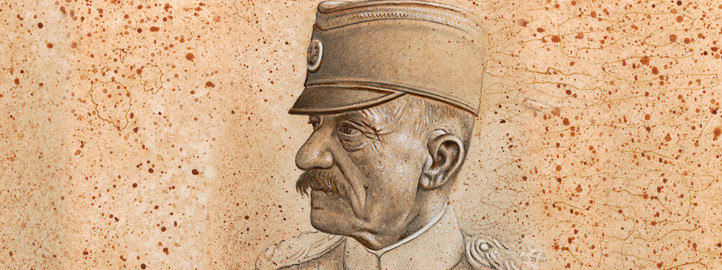
Mihailo Papazoglu
Gavrilo Princip,
the man who foreboded freedom
The WWI Allies – UK, France, Russia, Belgium, USA, Italy, Greece,
Romania… Canada and Kingdom of Serbia – on the same side of
history. The right one.
Sarajevo, Bosnia, 28 June 1914. Some 400 years under Turkish Ottoman
and almost 40 under Austro-Hungarian occupation. People of some
dozen different nationalities sharing the same dream of freedom. Gavrilo
among them. Shooting at the Austria’s Crown Prince. For many
of his fellow countrymen he is a freedom fighter. A “terrorist” some
may say? Let’s put a question mark here. However, these shots did announce
the beginning of warfare… Memento mori.
Belgrade, Serbia, 28 July 1914. Just one month later. First artillery
shells in WWI began to fall on the city’s Danube and Sava river banks
and neighbourhoods under the hot, burning summer sun. For Serbia
this is the end of a one month long diplomatic prelude that started
with Gavrilo’s shots, followed by a written ultimatum delivered to
Serbia. Austro-Hungary, a 52-million people empire gave a 48-hour
ultimatum to a 5-million nation. Nowhere to hide. The declaration of
war was sent by a telegraph message. An urgent one. At that time
“blitzkrieg” was not invented yet, but a punitive military campaign in
the Balkans was imminent. Waltzerkrieg? Sounded easy. To easy…
You’ve probably never heard of Dušan Đonović. A sixteen year old
Serbian Army volunteer born in Crmnica shot in Belgrade by gunfire
from an Austrian Danube Flotilla vessel that very first day of war. The
first victim of WWI. He died like 1.250.000 other Serbs. Death toll: 28%
of population total, both soldiers and civilians. Maybe you’ve heard of
George Lawrence Price? Born in Falmouth, Nova Scotia, age twenty
six. Served with “A” Company of the 28th Battalion, Canadian Expeditionary
Force in Belgium. Fatally shot by a German sniper at 10:58
a.m. on November 11, 1918. He died just 2 minutes before the armistice
ceasefire that ended the war, coming into effect at 11 a.m. The last
victim of WWI. He died like 61,000 fellow Canadians. Like 17 million
people in Europe and around the world.
In between, we fought. For one year on our soil. On our frontiers.
Mostly alone. The first allied victory took place in Serbia, in the mountains
of Cer. Then the second one in Kolubara. Almost like the battle of
Vimy Ridge. This success drew worldwide attention to Serbia and won
the Serbs sympathy of both neutral and Allied countries, as it marked
their first victory over the Central Powers. The next year we had our
share of defeats. Belgrade, the capital, was the last stand for more than
2,600 Serbian Army soldiers who defended Belgrade, aware of the fact
that their names had already been erased from the list of the living by
the Serbian Army HQ. Left behind as an ultimate sacrifice. Not to be
forgotten. Ask any kid in Serbia today for this episode of war – they
know it! Once again we survived barely enough to align in trenches
of the so-called Salonica Front in Greece. No different from Passchendaele
and the Canadians. For those three years of war in exile we lost a
country – but saved the state and the statehood. Population was left to
occupiers – but we saved the nation. We never lost faith. And the currency
– the dinar – kept his gold based value through the war! Finally,
along with the allies, 1918 we were free.
And what was Gavrilo doing at that time? He was imprisoned in
the dungeon of the fortress in Theresienstadt (Terezin in today Czech
Republic) that was used during the WWII as a Nazi concentration
camp for more than 150,000 civilians. Majority of them were sent to
death to other extermination camps, while some 33,000 people died
there from starvation or disease. They shared the fate of Gavrilo, who
officially died from tuberculosis, with his arm and shoulder amputated.
Gavrilo, an underage self-proclaimed freedom fighter, never got to
see the Armistice in 1918 and the liberation he gave his life for. He died
six months earlier and was secretly buried, so that his body is never to
be found. This leaves no empathy, nostalgia or second thought about
the Austro-Hungarian institutions’ operational mode. Why did it all
happen? Simply because he refused to switch from being the Turkish
Ottoman to Kaiserlich und Königlich colonial subject and from Middle-
East model of apartheid to a Mitteleuropa one.
Why did I title this essay – Gavrilo Principal, the man who foreboded
freedom? Take a look at the photo below. The inscription on the
plate in Serbian says: “On this historic place Gavrilo Princip foreboded
freedom”. It is a marble plate put after WWI at the very place
where the Crown Prince Ferdinand was shot. And who is this “gentleman”
looking at the plate delivered to him on his very birthday, 20
April 1941, as a birthday present, with an expression of accomplished
revenge? Just brought from the City of Sarajevo as a must, in the first
days of the Nazi occupation during their campaign against the Kingdom
of Yugoslavia and Greece, the plate was “a symbol of German
humiliation in WWI”, according to Hitler.
The theory of Gavrilo Princip being a terrorist would make Adolf
Hitler a crusader! Some really thought so. Luckily, there are not in this
world any more.
Bosnia, 28 June 1914. Gavrilo Princip had a pistol. Just one. He himself
was a trigger. The stage was setup long ago and the bloodshed began.
For the colonial empires of the time, their era was about to finish.
Game over. The Serbs fought against a couple of those empires. To survive.
For the right to exist. We fought bravely. Like others. We fought
to see another day. And to see – their backs. Been there. Done that. Still
standing. Proudly. With no lessons to give to anybody. Especially not
to history. Just for the record.
So, Gavrilo Princip, a “terrorist”, same may say? Negationism. A
simple question mark will really do. Otherwise, it means simply condemning
him. Without a court. Without a fair trial. For the second
time. One hundred years later. Post mortem. Allied countries included.
Serbia and Canada fought on the same side of history. For the right
cause. The aftermath of the WWI led Canada to full independence and
Serbia to full self-confidence in the international arena of that time.
Serbia, along with others, paid a high price in human lives during
WWI. Never to recover, as some say. Collective memory of the WWI
became the corner stone of our respective nations identity.
History made Serbia and Canada allies in both world wars. Modern
world and globalisation made us neighbours. Let’s make the future
seal this partnership.

Draga Dragašević
Canada’s First National Internment Operations, 1914-1920: The Serbian experience
Across Europe and the world the 2014 remembrance of the centennial
of the commencement of the Great War focused on the tragedy that
had unfolded on the ancient continent. Commemorative books, films,
speeches and concerts all conveyed the enormous impact of the fouryear
conflict. As the winds of war gained momentum one hundred
years ago, the catastrophe that affected the Serbian nation reached
cataclysmic proportions unprecedented in our ancestral history – the
loss of 27% of the population to war, slaughter and disease and the
threat of Serbia’s total annihilation by the mighty Austro-Hungarian
Empire. Notwithstanding the enormity of the human losses and sacrifice,
the “war to end all wars” failed to end the bloodshed of nations.
Not many years passed before tensions regained momentum in the
same theatre of war, in the newly formed Kingdom of Serbs, Croats
and Slovenes – later Yugoslavia – where the ferocity intensified and
even surpassed the horrors of World War I causing even more agony
for the Serbian people.
While the old continent was groaning under the endless explosions
of guns, cannons and bombs and Serbia was lamenting the
monumental catastrophe evolving on its terrain, there were tensions
in faraway Canada where Serbs and other ethnic groups had emigrated
choosing to leave the cherished hearths and homes of generations
rather than be subjected to the oppression of the Austro-Hungarian
Empire. One aspect of the war chronicles was not marked during the
centennial, namely a tragic episode in Canadian history related to the
catastrophe overseas – Canada’s unjust treatment of many of its immigrants
from Austria-Hungary. “During Canada’s first national internment
operations of 1914-1920 thousands of men, women and children
were branded as ‘enemy aliens’. Many were imprisoned. Stripped of
what little wealth they had, forced to do heavy labour in Canada’s hinterlands,
they were also disenfranchised and subjected to other state
sanctioned censures – not because of anything they had done but only
because of where they had come from, who they were.” 1)
In fact, the internment of East Europeans during World War I and
beyond was almost lost to oblivion, but a chance discovery 37 years ago
by Ukrainian Canadian professor Dr. Lubomyr Luciuk salvaged the
painful story from the dustbin of history. Years of lobbying efforts by
Canada’s Ukrainian community to obtain government acknowledgement
of Canada’s first national internment operations yielded a posi-
tive result. “In May 2008 representatives of the Ukrainian Canadian
community reached an agreement with the Government of Canada
providing for the creation of an endowment fund to support commemorative,
educational, scholarly and cultural projects intended to
remind all Canadians of this episode in our nation’s history.” 2) Mary
Manko Haskett, the last survivor of the internment operations who
was a child in the Spirit Lake internment camp, charged us “to never
forget what was done to her and all the other internees. She did not ask
for an apology, or compensation. She asked only that we secure their
memory.” 3) The silenced voices would be remembered.
Canada then and now
Technically, Canada’s demographics have always been reflective of a
diversity of immigrants. In the 1960s, the Royal Commission on Bilingualism
and Biculturalism focused on the British and French as the
“two founding nations”, and served as the foundation for a response
from the third segment of the population – the ethnocultural communities
who had been settling and developing this land, mainly since the
19th century. As a response to the Commission’s report, the Government
of Prime Minister Pierre Elliott Trudeau implemented a policy of
multiculturalism in October 1971 which recognized the third element
in Canadian society within the framework of bilingualism and biculturalism.
The development of that policy over more than four decades
confirmed what was already a reality – Canada has always been
a diverse society. “Cultural pluralism” was officially acknowledged
as the essence of our national identity, a program which encouraged
adaptation, retention of languages and cultural heritage within the
Canadian framework and reinforced equality and inclusiveness. In
other words, immigrants would be included in the national partnership.
It was a groundbreaking policy whose goal was to accommodate
the changing demographics in the interests of Canada’s harmony, cohesiveness
and prosperity. Since then, Canada’s approach toward immigrants
has been generous, especially toward refugees from war torn
regions of the world. True to its beneficence, Canada has assisted millions
of immigrants in adjusting to a new society, helping them with
official language acquisition, education, employment and social services.
Sadly, that was not the case in 1914. What happened in the past was
inconsistent with the values Canadians cherish today.
Canada’s immigration policy from 1891 to 1914 recruited East Europeans
to settle the Prairies and develop the huge expanse of empty,
fertile land. Canadian Pacific Railway posters can still be found promoting
passage for a nominal fee of fifteen dollars, affordable even by
contemporary standards. Thousands of citizens of Austria-Hungary
seized the opportunity, eager for a better life and anxious to escape
the yoke of Austro-Hungarian rule. Reaching Canada’s eastern shore
at Halifax, immigrants from many diverse ethnic backgrounds produced
Austro-Hungarian passports – and in some cases Ottoman
passports – proof of their birth and/or citizenship in the vast Empires.
Guided only by citizenship status, while unfamiliar with the foreign
names and the disparate ethnic composition of the Empires, Immigration
Officers did not register the ethnic origin of the new arrivals.
Individually, the immigrants were simply registered as “Austro-Hungarian”
or “Austrian”, or in some cases as “Ottoman” or “Turk”, an
inaccuracy which cost the new arrivals dearly only a few years later
when the Great War broke out.
Why was the precision of the name registration so vital? The Dominion
of Canada was part of the British Empire and naturally took
up the British cause when it entered the war on 4 August 1914 against
Germany and its allies, the Austro-Hungarian and Ottoman Empires.
Canada’s membership in the Allied Powers meant that it was also an
ally of Serbia and Montenegro whose passports guaranteed protection
for their émigrés in the war environment. Canada directly supported
the Kingdom of Serbia by sending medical delegations to assist the
war ravaged country. English and Scottish medical personnel also offered
their assistance. On the other hand, since Canada was officially
at war with the two Empires, its many immigrants from those territories
were immediately placed under suspicion, regarded as disloyal to
Canada and labeled “enemy aliens”, an unjust stigma that led to severe
consequences.
It was a very different Canada at the turn of the 20th century. Canadians
were fearful of these immigrants who looked different, dressed
differently and spoke strange languages. Xenophobia was rampant
in the general population stoked by hostile pronouncements of some
politicians and the media. Those factors, in conjunction with the pejorative
label, set the stage for the internment tragedy which followed
between 1914 and 1920. Australia, New Zealand and South Africa also
had internment operations, but with Canada’s climate, the operations
here proved to be the harshest.
War Measures Act
On 22 August 1914 Canada implemented the War Measures Act 4) which
mandated state-sanctioned deprivation of all civil rights including:
disenfranchisement; restrictions on freedom of speech, movement and
association; confiscation of little accumulated wealth and property; internment
and deportation. This Act came into effect two more times
in Canadian history: on 3 September 1939 inducing the internment of
Japanese, Italian and German Canadians during World War II; and
on 16 October 1970, the only peacetime enforcement of the Act in response
to the Quebec Crisis. Later criticized for its severity and the removal
of rights such as “habeas corpus” which safeguards individuals
against illegal detention or imprisonment, the War Measures Act was
repealed on 21 July 1988 and replaced by the Emergencies Act which
_______________
1) Canadian First World War Internment Recognition Fund (CFWWIRF ).
Recognition, Restitution & Reconciliation. Poster. 2009
2) CFWWIRF . Poster.
3) Lubomyr Y. Luciuk, Without Just Cause: Canada’s first national internment
operations and the Ukrainian Canadians, 1914-1920 (Kingston: Kashtan
Press, 2007): 56.
4) http://en.wikipedia.org/wiki/War_Measures_Act
Milan Grbа
Britain and Serbia in the WWI: British policy, public responses and humanitarian aid to Serbia
Introduction
This paper was prepared for a Serbian Council of Great Britain event
at the British Library in commemoration of the centenary of the First
World War on 3 November 2014. Two introductory parts of the paper
“British policy” and “Serbia’s war” are edited for publishing and their
main points are briefly suggested here. The central topic of the paper is
unedited version of the talk given at the event.
British policy during the July Crisis, which ensued after the assassination
of the Archduke Franz Ferdinand in Sarajevo on the 28th of
June 1914, was a policy of peace in Europe. Following the declaration
of war on Serbia, Britain was still keen on mediation and to this end
was ready to accept Austro-Hungarian occupation of Belgrade and
other places in Serbia. In the end Britain was compelled to go to war
to defend Belgium and France against German aggression. Britain
was less concerned about Austro-Hungarian hegemony in the Balkans
than about German hegemony in the world. Britain’s most immediate
war aim was the restoration of Belgium, not Serbia.
British official policy towards Serbia was multi-layered. British
Balkan experts had a strong impact on British policy towards the Austro-
Hungarian Monarchy. They argued for a strong and independent
South Slav state to serve as a bulwark against German expansion to the
south-east of Europe. British official thinking was also informed by
the Serbian minister in London and the exiled South Slav politicians.
British politicians and Balkan experts worked hard to form a new
Balkan alliance of Romania, Bulgaria, Greece, Serbia and Montenegro.
To this end, Britain expected Serbia to make sacrifices by offering to
Bulgaria the territories in Southern Macedonia acquired in the First
Balkan War, the so-called ‘Uncontested Zone’ in Macedonia. The British
belief was that a Balkan Alliance would bring victory in the war
which would enable Serbia to acquire, in exchange for the territories
in Macedonia, Bosnia and Herzegovina, Serbian areas of Slavonia and
part of Dalmatia with access to the sea. However, the drawing of Italy
into the war involved South Slav populated territories along the eastern
cost of the Adriatic. According to the Treaty of London of April
1915, Italy was to receive Austrian Istria, the northern part of Dalmatia
and most of its islands. Serbia remained unwilling to secede most of
the Uncontested Zone of Macedonia to Bulgaria in exchange for new
western territories including access to the sea.
British politicians did not give guarantees of support for Yugoslav
union until the very end of the war at which point the British policy
evolved towards the right to self-determination. In the end it was the
collapse of Austria-Hungary and the Italian Adriatic designs that
brought the Austro-Hungarian Croats, Slovenes and Serbs together in
union with the Kingdom of Serbia.
Serbia’s war was a nationwide and defensive, a war for survival, but
her political and national aspirations were guided by ethnic and historical
principles. Serbia had laid her claims to the South Slav territories
within the Austro-Hungarian Monarchy and the Ottoman Empire
before the conflict.
All Serbian war governments were staunch allies and loyal supporters
of the Entente for the duration of the war without a formal treaty
between Serbia and the Entente. The Entente unreservedly supported
and financed the Serbian war effort until the end of the war, though
not entirely her political and national aspirations.
The death toll in Serbia in the First World War was the highest of
all, and amounted to around one million people, or over 22% of her
pre-war population of over 4.5 million including Kosovo and Macedonia
from 1912. More than half of the mobilised men were killed in
combat or died in war – around 370,000 troops. The number of dead
civilians in Serbia was at least 600,000. Civilians in Serbia died from
atrocities in the war and enemy retribution, or as war casualties in
the territories which were overrun several times by the enemy forces
in 1914. The majority of people died from contagious diseases, famine
and cold.
Humanitarian aid
In 1914 Serbia entered her third war in the last three years, unprepared
for it in every way. The Balkan Wars had exhausted her limited resources,
and the country needed a period of peacetime to recover, integrate,
and to continue her modernising processes in the army, government,
transport infrastructure, health, education and so on. When in the
summer of 1914 an influx of numerous sick and wounded soldiers
began, the army and mobilised Serbian doctors, part of a total of 450
doctors in Serbia, could not meet the medical needs of the army nor the
needs of the country’s civilian population without foreign aid. The first
foreign doctors and medical workers, including British personnel, arrived
on three-month Serbian government contracts from August 1914.
The American wife of a Serbian government official, Mabel Grujić, had
organised a group of British nurses in London and arrived with them
in Serbia in August 1914. A month later she sent a letter from Serbia to a
Balkan War veteran nurse: My dear Lady Paget, My husband just told
me that a telegram has come saying that you are coming out to us and
bringing a large force of Surgeons, Aids and Nurses, in addition to the
unit which the Red Cross is sending. That is truly brave and splendid
of you. How often have I wished for you since my arrival here a month
ago. As you perhaps know, I brought out nine English nurses with me,
and I took them to Kragoyevatz to work under Colonel Sondermayer.
There are 1300 wounded in that one hospital, only these sisters and a
few Servian women with the usual “Bolnitsa’s.”
Reports of the Austro-Hungarian atrocities committed against the
innocent civilian population, the Serbian military successes against
an overwhelming enemy and the bravery of the Serbian troops deeply
moved the British public, turned round the public sentiment and
aroused sympathies in Serbia’s favour. In this atmosphere of public
support for Serbia, on the initiative of Bertram Christian, a former
Balkan Wars correspondent, the Serbian Relief Fund was founded
in London in September 1914. This organisation brought together respectable
and influential public personalities, members of parliament,
cabinet members, British Balkan experts, academics, journalists and
other friends of Serbia. In February 1915 Queen Mary became Patroness
of the Serbian Relief Fund. During the course of the war the
British public responded more than generously to the Serbian Relief
Fund through numerous public appeals, demonstrations of support
and events, and thanks to this generous public response many thousands
of Serbian lives were saved. The immediate task of the Serbian
Relief Fund was to raise funds for a medical unit to be sent to Serbia.
Lady Paget was in charge of the first unit, which arrived in Skoplje in
November 1914. By June 1915 the Serbian Relief Fund sent five medical
units to Serbia, fully equipped and supplied for independent hospital
work. These hospitals were based in Skoplje, Kragujevac, Belgrade
and Požarevac. Tons of sanitary supplies, medical materials, hospital
equipment and medicines and other necessities were shipped to Serbia
on an Admiralty transport from Southampton to Salonika thanks to
close cooperation with the British government. The sea voyage from
Britain to Salonika via Gibraltar and Malta usually took 17 days. The
humanitarian aid to Serbia paid for by the British public and raised
by many different committees, charities and organisations in the first
years of the war was greater and more visible than official British aid.
The Scottish Women’s Hospitals for Foreign Service were founded
in Edinburgh in the autumn of 1914 and originated from the Suffragette
movement. The idea of proving the equality of women was embodied
in the foundation of hospitals which were composed only of
female staff, from surgeons to orderlies. Dr Elsie Inglis, the founder of
the Scottish Women’s Hospitals, was a leading figure in the struggle for
the emancipation of British women. When the services of the Scottish
Women’s Hospitals were turned down by the War Office, Dr Inglis offered
their services to Belgium, France and Russia, and later, having
met the energetic Mrs. Grujić in London, she extended them to Serbia.
The Serbian Government accepted the offer with alacrity in October
1914. Before the first Scottish Women’s Hospitals left Southampton
for Serbia in December 1914, the news arrived that Belgrade had fallen
into enemy hands and that the Serbian army, lacking food, rest and artillery
shells, was withdrawing before the enemy advance. The news of
another great Serbian victory reached them before their arrival in Salonika.
At Salonika the Scottish Women’s Hospitals received an order
to proceed to Kragujevac where help was urgently needed. Their first
stopping place was Niš, where the army authorities showed them the
largest hospital in town. Mr. William Smith of Aberdeen who went
John Reed
Land of Death
www.serbia.com
Soiled, torn streets, clouds of smoke and dust, smell of gunpowder,
arsons and rotting human bodies piled on top of each other: this was
the picture of Serbia in the Great War. The courage of this small country
that has stood shoulder to shoulder with the world powers, has
intrigued many. Among them was an American journalist and writer
John Reed, who visited this “land of death”, as he himself named it,
being unaware that he would even take part in a ritual of fraternization
at the end of his journey, at the insistence of a postman from
Obrenovac.
The journey of John Reed was concentrated on the route of Niš –
Belgrade – Kragujevac – Rakovica – Ada Ciganlija – Obrenovac –
Šabac – Prnjavor – Loznica – Gučevo – Krupanj – Zavlaka – Valjevo.
Over the course of his expedition through the tormented country,
Reed made convincing descriptions of landscapes, soldiers, ordinary
people and buildings that even nowadays represent a unique portrayal
of life, death, poverty, as well as courage, dignity, faith and hospitality
of the Serbian people and the army.
Niš, A City Decimated By Typhus
The horrors of war, vicious diseases and death did not bypass Niš, which
was the first “station” for Reed in his war travels. Passing through the
city stricken with typhus, as if a malignant tumor engulfed it, without
a hint of embellishment Reed describes the houses with long, black,
sinister flags, and pale, exhausted faces of prisoners leaning on dirty
blankets and protruding through the window of the hospital, while in
the front – dozens of them lie in the dried mud.
On muddy and plowed streets of Niš, the Austrian prisoners in
uniforms roam freely. Some haul the cart, others dig trenches, and
hundreds of them are idly strolling up and down. Crossing the muddy
Nišava river at the foot of the bulwark of the famous Niš fortress, Reed
sees hundreds of soldiers lounging, sleeping, removing lice and shaking
with fever. Further down the road to Belgrade, John Reed and his
companion, an illustrator – Bordman Robinson, meet the representative
of the Press Bureau Vojislav Jovanović Maramba.
Belgrade, A Quiet City Destroyed By Bombs
Like much of the town, the Belgrade railway station was bombed and
destroyed. Reed, Robinson and Maramba got out at the station in Rakovica,
and travelled in a ramshackle carriage to the city center. Reed
then wrote: “The grass and weeds are growing between the cobblestones,
no one has passed here for half a year, and the guns are completely
silent. The consequences of cannonfire are visible everywhere.
Large holes having 5 meters in diameter gape in the middle of the
street.” A thought that the Austro-Hungarian guns can resume bombardment
at any moment, as they have done dozens of times, was the
constant threat in the air.
Military Academy, Ministry of the army, King’s palace, University
of Belgrade and ordinary houses, sheds, restaurants and hotels were
often without roofs and doors, and window frames without glass were
swaying aimlessly in each building. After touring the trenches built
for Belgrade’s defence, and travelling on a cargo ship “Nebojša” that
had countless loopholes drilled on the sides, they reached the makeshift
firing nests where the soldiers were lying facedown in a muddy
embankment, unshaven, unwashed and gaunt from malnutrition.
Following a meandering and furrowed road, they went further into
the deep interior of Serbia, glancing for the last time at the white city,
which was refusing to surrender.
Mačva and Drina, Havoc Causing Grief
The road led Reed and his companion to the areas where, except soldiers,
men were gone. The vicious disease typhus devastated those
lands. After about a kilometer of walking Reed was able to count one
hundred white crosses on the fences of houses, and each meant that
typhus claimed at least one life in that house. “It seemed that this lush
and fertile land consists of nothing but death and commemoration,”
noted Reed. The landscapes they passed through suffered the most in
bloody battles of 1914.
The train they were traveling in was full of miserable refugees,
mostly women and children who were forced to leave their homes due
to the cruel military attacks of Austria-Hungary. The whole area was
burned, looted, and people were slain. For miles, it was almost impossible
to see neither a bull, nor a man. “Sometimes our train stopped so
that refugees could get off. They were standing right next to the railway
with all their assets packed in a bag over the shoulder and silently
watched the ruins of their country,” wrote Reed.
Gučevo, A Death Valley
Reed presented his strongest condemnation of the war by describing
Gučevo and the huge losses that the Serbian army suffered in
that region. During the second attack the Austrians seized the peak
of Gučevo, and they entrenched there. Under the enemy’s hurricane
fire the Serbs scrambled step by step, until their trenches formed on a
narrow ridge. Then, on the 16 kilometers front, at the very top of the
mountain, one of the most horrific battles in the Great War was fought
– The Battle of the Drina. After 54 days of bloody and difficult struggle,
the Serbs withdrew, only because the third Austrian invasion broke
through their lines in Krupanj.
There were abandoned huts covered with leaves and branches, and
dugouts in which the Serbian army lived for two months in the snow,
all over the forest. The lower parts of the trees were covered with leaves
whilst the top parts looked lifeless. Nine kilometers along the peak of
Gučevo, dead soldiers were stacked, 10,000 of them.
Sir Tomas Lipton
The terrible truth about Serbia
London: Brit. Red Cross Soc., (1915)
Gallant little Serbia! How magnificently has she played her part in this
great world struggle, the greatest of all time! Thrice already has she
flung back the Austrian invader, chasing him from her borders. She
at least has thrown every ounce of her strength into the scale, and the
memory of her deeds wiIl never die. Now in the flush of her triumph
our brave little ally is threatened by a new arid terrible foe against
whom valour and the sword are powerless. The warrior nation whom
the might of Austria could not subdue is likely to be overborne by an
invisible enemy – typhus.
I have recently been privileged to visit Serbia and to traverse the
whole length of the country. In the course of my journeyings I was able
to see with my own eyes the grievous affliction which has fallen upon
her, and the noble fortitude with which she is enduring what she is
helpless to combat. In the following pages I shall try to give my readers
som, account of things which must be of vivid interest to every man
and woman in this land. Are not the Serbians our brothers in arms?
We have learned a great deal about Serbia during the past few
months, and it is my conviction that we shall learn a great deal more
in the near future. As it often happens with nations (though by no
means always), the better we know her, the more we find to admire.
Our admiration is warmly returned – that I know. The Serbians have
a most touching belief in the British nation. Wherever you go you find
that, even among the poorest peasants. It seemed to me that their everpresent
desire was to win the approval of England. Yet, poor as they
are, they are a most independet people – a Serbian would rather starve
than beg. And as for bravery, whenever and wherever they have had
the opportunity they have proved that there is no braver nation in the
world. No men have surpassed them in this respect. They do not fear
death at all on the battlefield.
But worse almost than deaths or wounds, the privations endured
by the tiny army during the terrible winter campaign laid them open
to the onslaughts of disease. Concurrently the flight of poor refugees
from the area of hostilities to the towns and villages behind the front
induced conditions of overcrowding with which it was impossible to
cope in a proper manner.
Tile difficulty was enormously increased by the vast numbers of
Austrian prisoners for whom it was necessary to find lodging. It is
said that it was among the latter that the dreaded typhus fever first
developed. It is more than likely to be so. In any case the disease, once
having made its appearance, spread with frightful rapidity, until now
it has become an enemy more deadly than the Austrian. In the very
flush of victory indomitable Serbia has been attacked by disease as I
think no country has ever been attacked before. It is a plague such as
the world has seldom known, and all the benevolence of humnanity
will be required to deal with it. And smallpox and scarlet fever are
helping to sweep away thousands in all ranks of life.
Doctors tell us that typhus is essentially a disease produced by
famine and overcrowding. Our own land has suffered grievously from
it in times past, but the advance of sanitation has enabled us to overcome
it, and typhus is almost unknown in Britain at the present day. In
Serbia it is otherwise, and a moment’s reflection will show that this is
perfectly natural. What need has a robust peasant community for the
science of sanitation?
Until this calamity fell upon her Serbia was one of time healthiest
countries in the world. Typhus has come upon her unawares, and she
is helpless. Shall we not help her? She is our ally. By her prowess in holding
a quarter of the whole Austrian army at bay she has done all and
more than all that should or could be asked of her. Not only that, but
who can say how far the disasters which have befallen the Austrian
arms in other spheres of the war are due to the loss of morale inflicted
by Serbia?
Serbia has fought three wars in gallant defence of her native land,
and the resources of the country are now strained to the utmost. Nis,
with a normal population of 15,000 to 20,000, is now packed with
over 100,000. In that overcrowded town there are many thousands of
typhus cases; deaths have averaged 140 a day – on one day alone nearly
300 people died of typhus and the cemeteries were unable to receive the
dead. Typhus carts drawn by oxen rumble through the streets, bearing
as their burden men raving in fever and delirium. On the street
pavements I saw white-faced men sitting shivering in the first grip of
the disease, unable to drag themselves to shelter, and waiting for the
bullock-cart to pick them up.
At Djevdjelija and Nis and Belgrade, and even at Kragujevac, the
headquarters of the army, typhus, the dreaded disease, is spreading
like a terrible blight from which neither man nor woman nor child
of any station in life is immune. What is happening to the women of
Serbia I dare not think. In all the hospitals of Serbia I did not once see
a woman patient. They are all filled with men, so there is no room for
women, who, I fear, must die in their own homes for want of doctors
or medicine to save them. Dr. Ryan, the chief of the American Red
Cross Mission in Serbia, at Belgrade, where he has the best hospital in
the Balkans under his charge, with nearly 3,000 patients, told me that
unless something is done immediately to stop the disease more than
half the population of Serbia will be wiped out. As I write this I see by
the papers that Dr. Ryan is himself lying very ill with typhus.
Although I noticed the Red Cross flag over nearly every large
building throughout Serbia, the hospital accommodation is quite inadequate
for the thousands of patients. How many thousands of cases
there are I cannot say, because exact and accurate figures are unascertainable.
Mrs. Hankin Hardy, who has charge of an old prison turned
into a hospital at Kragujevac, told me that day after day men in the
delirium of typhus were brought in ox wagons to her door, and were
laid there to die because there was no room for them inside. Multiply
this by a thousand cases, and you have Serbia as it is to-day.
Even more grievous is the paucity of doctors and nurses, and the
lack of sick-room necessaries. Mrs. Hardy, whose husband is an army
chaplain at the front, and whose children are in England, slept in what
had been a prison cell. She told me she had over 600 patients, and neither
a doctor nor a nurse to attend to them. She lacked almost everything
in the way of medicines and disinfectants. I asked her how she
managed with her patients. She replied that the only help she had was
from some Austrian prisoners, who were in anything but a clean condition
to wait upon the sick. In some hospitals they had neither blankets
nor mattresses; in some the mattresses were put sideways, and
three or four patients were lying on one mattress. Yet the men have
never a word of complaint. In one ward I saw a fever patient whose
magnificent voice was booming songs to cheer his comrades.
In passing through Djevdjelija I was met at the station by Dr. Donnelly,
who asked me and my party of doctors and nurses to visit the
hospital, as we had two and a half hours to wait at the station. Djevdjelija
is a village in a barren, uncultivated country, the hospital an
old tobacco factory formerly belonging to Abdul Hamlil. In it were
crowded 1,400 men, some witimout blankets or mattresses or even
straw – men lying in the clothes in which they had lived in the trenches
for months, swarming with vermin. All diseases – typhus, typhoid,
dysentery – were herded together when Dr. Donnelly arrived, he said.
But the hospital was being improved and the patients distributed into
different wards. He had a force there of six American surgeons, twelve
American nurses, and three Serbian physicians. When I visited the
hospital three American physicians, the three Serbian physicians, and
nine of the nurses were themselves ill. The patients were waited on
by Austrian prisoners. The fumes of reeking wounds and fever were
unbearable.
The first thing the doctor had done on his arrival was to test the
water, which he found infected. He then improvised boilers of oil
drums, in which to boil water for use. The boilers saved five hundred
lives, said tile doctor. He also built ovens in which to bake the clothes
of the patients; but he was not provided with a proper sterilising apparatus.
Before the train started Dr. Donnelly, with two of the Amnerican
nurses whom I had not seen, came to see me off. They had a talk with
a number of the nurses in my party, and I gave them some little hospital
comforts to take back with them. While waiting at the station Dr.
Donnelly told me he was afraid the Bulgarians might attack that district,
and he would like to have a large American flag, which he would
hoist in a conspicuous position in order to protect the hospital. The
Radojka Vukcevic
War in the media and the English language:
the case of Yugoslavia 1999 bombardment
For most human beings in the Western world, watching television has
become the principal means of interaction with the new world now
under construction, as well as a primary activity of the everyday life.
At the same time, the instructions at the fulcrum of the process use
television to train human beings in what to think, what to feel, and
how to be in the modern world. In the text that follows I examine
additional impacts of television in the world today in the case of 1999
NA TO bombardment of Yugoslavia. I examine the war they led in the
English language at the same time.
“Our media are our metaphors. Our metaphors create the content of
our culture,” says Neil Postman (Currents of Inquiry, 250), while Jerry
Mander, an American author, recognises the critical role television
plays in the larger technological web. He claims that in this society life
has moved inside media-looking at and experiencing-a machine. The
problem is in the environment of TV, which is not static, but aggressive.
As it enters people’s minds leaving images within, television becomes
an internal, mental environment. Television synchronises our internal
processes to make them compatible with the world outside ourselves.
As a consequence our brain is put into passive “alpha”, a non-cognitive,
passive-receptive mode. The humans are receivers. “Television seems
to be engaged in some kind of weird mental training” (Against the
Current, 164). It is a drug, called speed. But TV not only trains younger
generations for drug dependency, it also trains them for commodity
dependency (It leaves them with feeling that they can’t experience life
without technological and chemical props).
On the other hand, television is supposed to be a democratic
medium. But if it is “democratic” on the receiving end, it is surely not
that on the sending end. For, at this end there are the largest corporations
in every country (In America 75 % of commercial network television
time is paid for by the 100 of them. They can afford it. 450,000
have no influence). The outcome of this is, as A. J. Libelling finds out,
“Freedom of the press is available only to those who own one” (Against
the Current, 166).
Television synchronises our internal processes, concludes Mander,
“with the new world of concrete, computers, space travel, and acceleration”.
It makes our insides-brain and nervous system-compatible with
the world outside ourselves. It puts out brains into a passive alpha state
while ‘zapping our thinking processes and destroying our creative impulses’.
Finally, a new human emerges: speed junkie, videovoid, technovoid.
George Orwell’s 1984 describes an information environment so
monolithic and aggressive that it becomes the total source and absolute
limit of human knowledge. In this novel every room has a two-way
“telescreen” that cannot be turned off; its non-stop programming consisted
of official music, economic data, and constant reports of military
victories. Here television becomes an instrument of daily training sessions
for human emotions via constant juxtapositions of the images of
Good vs. Evil; the benevolent, beloved Big Brother versus the hatred,
loathsome enemy, Goldstein.
Like in Orwell’s novel 1984, during 1999 media war against Yugoslavia
the effect of the total control of imaginary was to unify mass
consciousness within a single-media version of reality. Eventually,
people accepted even utterly contradictory “doublethink” statements
such as: “war is peace,” “hate is love,” “ignorance is strength.” Life and
television have merged, just like in the novel. Carl Bernstain, another
American author, joins Mender in seeing the role of American media,
but he asks for raising the same fundamental questions: about standards,
about self-interest and its eclipse of the public interest and interest
of truth. He, first of all, asks: “Who is served?”, and then concludes:
“They-or more precisely, we-have abdicated our responsibility, and the
consequence of our abdication is the spectacle” (American Voices, 390).
Television was essentially an instrument of official policy during
the Persian Gulf War, and it still is, Mander claims. The two sources of
imagery – video games and war – became intertwined in the minds of
a society, and war itself became something of a giant video game. This
started in America during Ronald Reagan presidency. Mander analyses
Mr. Reagan as a man who spent his adult life being an image. He
knew that the way you look and behave is more important than what
you say or do. Above all, he recreated a set of images that had been
reinforced by standard story lines since World War II; he was making
real what was previously just imagery in the minds of the population.
Mander recognised that Reagan understood the antihistorical
nature of TV reality, its nowness. He also understood the power of one
single source to control human minds. And just as in 1984, real and
unreal, truth and fiction, became equally arbitrary, for there is no way
to clarify or check what is asserted on TV. “And so Reagan could call
his invasion of Grenada a ‘rescue’ of students who were never in danger.
He could assert that the Soviets knew that Korean Air flight 007 was
a passenger plane before they shot it down, though subsequent stories
suggested that Reagan knew that the Soviets did not know. By asserting
that Libya was behind the Berlin disco bombing, Reagan made that
true for millions of Americans, and we supported his bloody retaliation,
though later evidence showed that Syria had most likely created
that evident” (Against the Current, 178). Clinton obviously had a good
teacher when he did the same in the case of Albanians in Yugoslavia,
which enabled him to get a support from his people during the bombardment
of Yugoslavia.
TV media needs a specific Orwellian language in order to win its
video wars. Again, this started with Ronald Reagan as well. He called
MX missiles “peace-keepers.” He also said that lowering taxes on the
wealthy “benefited the poor”, and claimed that “massive rearming was
the way to disarm”. George Bush followed him a few years later by
claiming that “the last best chance for peace was to declare war against
Iraq”, and then said “the goal of the war is peace.” All these sentences
qualify as advanced “doublespeak” (Against the Current, 179).
Obviously, Reagan and Bush also understood the important Orwellian
lesson in focusing public hatred on the repeated images of the
enemy. Orwel had used the loathsome TV visage of Goldstein in “Two
Minute Hate” periods throughout the day. Reagan used Khomeni, then
Khadafy, then Ortega. Bush continued the tendency, focusing American
hatred on images of Willie Horton, then Manuel Noriega, then
Saddam Hussein. (Against the Current, 179) Clinton together with
eighteen more presidents used Milosevic, Saddam Hussein.
When Mr. Reagan said that video games were good training for
bomber pilots, explains Mander, he forgot to mention that video
games were good training for the people too since they enabled people
to truly identify with bomber pilots and brought people closer to
them. (It is amazing how images of the laser and radar guided missiles
brought about video games did enable the TV audience to identify
itself with the precision of the pilot’s tasks.) Jerry Mander recognises
in it the unique capability of the medium, equal to its delivery of
multifaced and multidimensional advertising imagery. It is obvious
that no other medium before created such a wonderful advertisement
combined with awe, for technology itself. Just as in Thomas Pynchon
novels: the vision of big high-tech wars (Gravity Rainbow, The Crying
Lot of 49) becomes reality.
Obviously, in the case of Yugoslavia bombardment the two sources
of imaginary video-games and war – became intertwined in people’s
minds, and the war itself became something of a giant video game.
This was so apparent that it was noted by mass media pundits. What
was not sufficiently noted but was amazingly odd was the following:
all people’s favourite toys-computers, television, video games, and war
games-had merged this way into something we could all experience
right up there with our real pilots. Still, there remained one area of
confusion. For unlike the video-game in video parlours, the actual
bombs had a final outcome that was not merely electronic: it was metal
against flesh. This many have not experienced.
But many have. About 11 million people in Yugoslavia during the
longest up-to-date 78 day video game of bombing of Yugoslavia played
by the 19 most powerful presidents in the spring of 1999. The final outcome
of the metal against flesh was this: by its intensity and military
might, it was the biggest one after World War II. It was undertaken
by NA TO, the alliance of 19 most developed countries in the world,
10 of which took part in the aggression with 1,100 planes and most
sophisticated weaponry. NA TO flew 25,200 sorties over the territory
of Yugoslavia, dropping 25,000 tons of explosives.
NA TO (metal) was unselective about its victims. Children, women,
men, and the elderly perished (1254) as well as mothers with their