

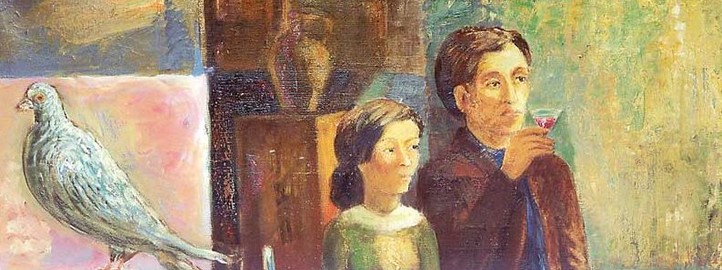
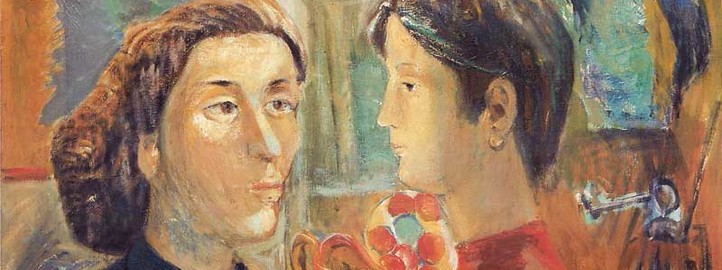
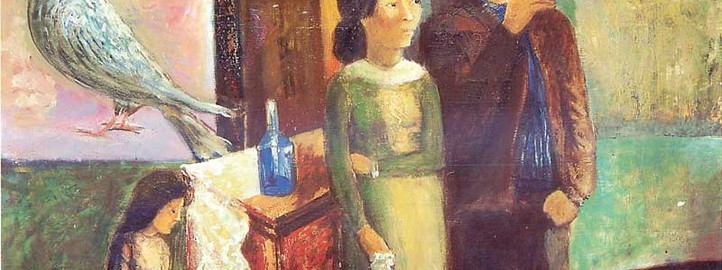
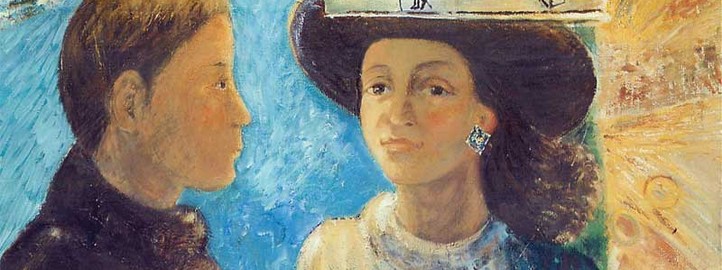
Radomir Baturan
Morava and Mattawa*
On the shores of Morava and Mattawa
My heart pounds
Morava with its familiar beat
Mattawa with a strange sad pulse
The Morava River fed by the Nile
The Mattawa frozen water and land
They are two snakes on two continents
But they are also drills going deep
There’s no end to the drilling
Until an eruption in blood
Once it was my native blood
The other’s a single scream
On Morava and Mattawa shores
The voice of a mother vainly calls
“Rade, my son, don’t forget me”
While a foreign soldier lashes with a whip
My heart drums fast at the Drina River
From its spring to the last breath at the stone bridge
Under a crescent Moon over the Morava valley
And on the Mattawa River bridged by ice
At the Morava and Mattawa Rivers
My heart still fills with a thrill
But the beats slow
Because an émigré’s sorrow never subsides
Oh, Morava River planted by Nile
Oh, Mattawa water bounded by ice
I survived and crossed every bridge
But found no peace in between the two of you
Rendition: Sofija Škorić and Fraser Sutherland
Acacias or Women
Dawn
Peels night from day
And morning gushes in
While my writing
On Armenians and Serbs
Ends
I gaze at a pastel
By metaphysician Rajkovic
Where drawn Bagdala’s acacias
Stroll
From ravine to ravine
Stepping up the hill
Glints of acacias
Glints of slender women
In white dresses
Across glades
They seem safe from falling
When my sight adjusts
And they vanish
Acacias or women
Gnaw
In gnawing passion
of bodies or conscience
I doubt
I try
to bite my palm
But I miss
instead of the hand
I’ve bitten off the ring
with some nearby skin
and I broke a tooth
I don’t know
what hurts more
the tooth or the finger
or the conscience
the thorn fidelity
of primordial gnaw
Soul
That
which tempts us
hurts often
pleases sometimes
soul it is called
Stormy
like seas
swayed
like hills
broken
like spears
ebullient
like butterflies
Soul
a scented field
a bloody wound
a pleasant breeze
a raging tempest
a song and a scream
That
which tries us
is a soul
in a man
Marks
Searching for
beasts
in the deep snow
revealed trail
Searching for people
in eyes’ twinkle
a shadow
deep
in a thriller
that lures
melts
or bleeds
soul mesmerized
young
and hot
to enflame
or burn
Searching for tracks
many
that point to the cave
but none that return
Life leaves
marks
that lead
to a man
Rendition: Antonije Baturan
_______________
*Mattawa means “Meeting of the Waters” in Ojibwa.

Željko Prodanović
The Advisor with the Hoof
’Herr Mozart,’ the stranger said, ’I apologize for troubling you at this
time of the night. I will tell you straight away why I have come. I want
to ask you to compose a requiem for our great friend, who will, in a
few days time, pass his beautiful soul over to the cranes.’
’I apologize if I am too curious,’ Mozart said, ’but who is this
’great friend’ of ours?’
’Phoenix,’ the stranger replied, ’the one who is always reborn and
the only living Phoenician.’
For a moment Mozart was absorbed in his thoughts, trying to
recall who that could be.
’If you would allow me,’ the stranger said, ’I can remind you of
who Phoenix is.’
’Certainly,’ the composer muttered.
’If I am not mistaken, you are a Freemason,’ the stranger began.
’And you must surely remember the day when you, in the Great Lodge
of Salzburg, entered this holy order. You remember that you were
then Hiram, the great master from Tyre, who had built Solomon’s
temple. And you were certainly proud of being in the role of the great
mason from Phoenicia, at least for a little while.
’I don’t doubt, either, that you know that the first ’great master’ and
teacher of all Freemasons was the Phoenician god Baal, the oldest of
all gods.
’When he saw how diligently the Phoenicians worked and how
bravely they sailed the seas, Baal’s gentle heart swelled and a tear
dropped out of his eye. From this tear Byblos was created, the first
town ever to be built.
’When the grateful Phoenicians built a temple on the other side
of Lebanon and gave it the name Baalbek – the temple of god’s tear
– Baal’s gentle heart swelled up again and he decided to give them
an extraordinary gift. ’The first child to be born in Byblos,’ he said,
’shall always be reborn!’ As you may have guessed, it was our friend
Phoenix, the only living Phoenician.’
’How exciting!’ Mozart said and smiled innocently. ’I apologize if
I am curious again,’ he added, ’but, who are you?’
’That’s a very interesting question,’ the stranger replied, ’but a
very complex one as well. I am, if you don’t mind – a satyr.
’I was born in Phoenicia,’ he went on, ’before the Flood, which, by
the way, never happened. I am the illegitimate son of Alleluia, the one
who brings the light, and his mistress Astarta, the beauty with a tear
in her bosom. When I was born they named me Baalzebub, which in
Phoenician means ’the lord of the shades’, and some malicious folks
changed it later into Beelzebub, ’the lord of the frogs’.
’Although my parents were of exceptional stature and beauty, the
great shining eye trifled with me in a very awkward manner. As you
can see, I have horns. My right eye is black and the other one green. And
on my left leg, which is shorter than the right, I have a hoof.
’I left Phoenicia a long time ago and for some centuries drifted
over Europe. A few years ago I started working for the great alchem-
ist from Weimar, Goethe. He is writing a play about a certain doctor
Faust, who allegedly sold his soul to the devil.
’As I said, I met Goethe in a tavern in Heidelberg while I was gam-
bling with some crooks. When he saw me, he said that I reminded him
irresistibly of Mephistopheles, the devil from his story. He offered to
employ me as an advisor and I had no reason not to accept. My job
entails visiting him from time to time and talking to him, so that he
could describe this enchanter as convincingly as possible.’
’If I understood you well,’ the composer said, ’you are in fact –
the devil.’
’Well…’ the satyr replied. ’Goethe maintains that I am part of the
dark force that always wishes to do evil, but always does good. Wheth-
er this is true or not, you can judge for your- self.
’But let us start from the beginning. One day some bedouins ar-
rived in the deserts south of Phoenicia, bringing with them an absurd
story about a promised land and the chosen people. The Phoenicians
named them ’Judeans’, which simply meant the bedouins from the
south. It was in the primitive minds of these nomads that the story of
the devil emerged for the first time. And its heroes were, believe or not,
our friend Phoenix and I!
’Being unable to comprehend the story about Phoenix – the one
who is always reborn – the Judeans began saying that he was not a man
but Satan, ’the one who deceives’ or, if you like, a liar and a cheat.
’Nevertheless, I liked this ridiculous story very much. As I was al-
ready a little bored with the role of a satyr and secretly always wanted
to be Phoenix’s shadow, I seized this unique opportunity with both
hands. And so I became Satan, a liar and a cheat, the angel of evil and
the prince of darkness.
’Centuries passed and I wandered through Phoenicia, frightening
bedouins and amusing the Phoenicians. Then I became bored with
that as well. So, I went to Greece and asked Hephaestos, the god of fire
and blacksmiths, to employ me, but he refused, saying that he himself
was ugly and lame and that he had had enough of his own shadow.
’For a while I roamed the Greek islands and then I had the incred-
ible luck to meet Dionysus, the god of wine and musicians. He gave me
the job of advisor for drunkenness and debauchery, and I can say that
it was the happiest time I spent under the sun. And then the Christians
arrived.
’The long forgotten story of Satan was resurfaced and, not wasting
a moment, I went back to Phoenicia. So, I became the devil again, and
my fame spread through the world at the speed of lightning.
’But, as we talk about the Christians, I must tell you something else.
It is about him, who, through no fault of his own, laid the foundations
of the biggest delusion in the history of the world – the Aramaean
from Nazareth.
’One day a young man on a donkey arrived in Jerusalem. ’I am a
shepherd,’ he said, ’tell me where my flock is!’ But the Romans arrested
him on the charges of preaching a new faith and condemned him to
death. Soon after they crucified him and that is the end of the story.
’Later on, however, some suspicious characters appeared, claiming
that the Aramaean had been their teacher and that he was crucified to
redeem the sins of all people. And that his last words allegedly were,
’My god, my god, why have you forsaken me?’
’Since I have the divine gift to travel through time and in order to
find out what really had happened, I decided to go back to that shiny
morning. And here is what I saw and afterwards wrote down as well:
’Oh heavenly eye, the great spring shining upon my face for the last
time!’ the Aramaean cried out. ’You are the witness that I, the son of
the shepherds from the Aramaic fields, guardian of winds and player
on the flame, am dying – not knowing why. Sunshine, sunshine, why
are you forsaking me?’
He closed his eyes and a flock of young cranes flew out of his heart.
And I, who know the secrets of earth and the secrets of heaven,
guardian of poets and young cranes, have owls from Lebanon and
crabs from the Orontes for witnesses , that all I wrote down, really had
happened – in the year 666 after Orpheus’s death.’
’This manuscript, titled The Gospel According to Satyr, exists even
today and can be found in the library of Baalbek.’
The satyr fell silent and Mozart blinked his eyes and whispered,
’This is really exciting!’
’A few centuries later,’ the satyr went on, ’the prophet from Mecca
arrived and gave me the name Eblis, which is Baal-isa or Baal’s apostle.
And here is what he said about me.
’When Allah created the first man all the angels allegedly fell down
in adoration before him, except me. When Allah asked me why I too
was not paying reverence to the one he had made with his own hands, I
answered, ’I am better than him. You have created him from mud and
I was made from fire!’ Then Allah banished me from heaven and now
I drift through the world deceiving people. And you know, of course,
that this is all utter nonsense.’
Mozart blinked his eyes again.
’But before I leave,’ the satyr said, ’I want to tell you one more thing.
A hundred years after your death, a man will be born who will describe
me in a brilliant way – Mikhail Bulgakov or Baal-gakov, that is, ’the
smiling tear’.’
’But how can you know,’ Mozart interrupted him, ’what is going to
happen in a hundred years time?’
’Well…’ the satyr said. ’You certainly know that time is round.
More precisely, it has the shape of an infinite circle. As I have been
enclosed in this magic circle for centuries, over time I have developed
a perfect sense for space. And as your fingers glide so easily from one
key to another, so I, too, fly with ease through centuries.
’So, what is going to happen? When you die, your soul will go to
Baalbek and spend one century there. Then the cranes will take it to
the north and in 1891, in Russia, our new friend Bulgakov will be born.
So, he will have your soul and, remembering our encounter, he will
transform it in a brilliant way into an exciting story.’
’But, satyr,’ Mozart said, ’we are now in November 1791. Does it
mean that my time has run out?’
’Unfortunately yes, my friend. But you have quite enough time to
write the requiem.’ ’But I am only 35 years old,’ Mozart whispered.
’My friend…’ the satyr said. ’I have already told you that time is only
an illusion. It does not matter at all how long you have lived, but what
you have done. And you played your role in the universe brilliantly.’
He stood up and out of his right, black eye, dropped a tear. ’So, my
friend, goodbye…’ he said and as silently as he had come, he vanished
into the night.
One month later, a little after midnight on December 5th 1791,
Mozart interrupted his work on the requiem for a while and lay down
to have a rest. And only a few minutes later there was a joyful cry of
cranes over the roofs.
’Oh satyr, satyr…’ murmured the composer, smiling, and one crane
flew down onto his shoulder. ’Let’s go, maestro,’ the crane whispered
and dropped a tear, and then they all flew to Baalbek together.
And one hundred years later, as I said, the great Phoenician writer
Mikhail Bulgakov was born, who, in his novel The Master and Marga-
rita, gave his version of the story of the famous satyr from Phoenicia.
Milo Lompar
Athens and Jerusalem in Njegoš’s poetry
The separation of the metaphysical, heroic and modern stages in
Njegoš’s poetry corresponds to the ancient, Christian and modern
senses of the world. Their contents exist as a reading track and spirit-
ual experience in Njegoš’s poetry. It causes us to contemplate the
constants in his poetry. It has a complex and multi-layered structure
which encompasses the elements of change of the metaphysical experi-
ence, which reveals the stages of the internal pathway through which
the metaphysical spirit flows, because it emanates – as Jovan Deretic
said – “from the inner core of the basic poetic meaning of the spark”
which represents the “common basic motif, poetic core, the nucleus
of the entirety of Njegoš’s poetry”.2 Only the metaphysical experience
changes itself in such a way and in such far-reaching transformation
that it passes through all three stages of Njegoš’s poetic experience.
Although one can discern the metaphysical experience in the ancient,
Christian, and modern conception of the world, it does not necessarily
exist in the same manner in each one of them.
There is no doubt that metaphysical experience resides in a differ-
ent way in different poetic forms and at different stages of the poetic
experience. Therefore, the Ray of Microcosm – in its central concept
– is primarily part of an unorthodox Christian experience of the world,
while the The Mountain Wreath – in its dominant reaches – achieves
the classical Hellenic sense of destiny. However, The False Emperor
Šćepan the Small – in its actuality and potentiality of suggestions – fits
the unorthodox sense of the modern world. Njegoš’s poems, however,
leave bursting traces in each of these concepts of the world. What is it,
then, that enables the constant swirl of the poet’s spirit? This issue has
great significance: it is what introduces us to the relationship between
Athens and Jerusalem in Njegoš’s poetry. That relationship is laid in
the foundation of our civilization.
Njegoš is a poet of the dramatic and authentic paradox that under-
pins our civilization. He is the embodiment of the connection between
Athens and Jerusalem. As a connection, he is a paradox; as a thought,
he is a contradiction; as an experience, he is an appeal. That appeal res-
onates with the modern. In fact, it is because of this paradox of poetic
experience that Njegoš echoes in modern sensibility, for modern sens-
ibility still thrives on both symbols: the cross and the circle.
In the world of heroic apologetics, at the very heart of the Kosovo
covenant, Njegoš does not only introduce the unknown but also an
inadequate figure in respect of the heroic expectation. Here is a sur-
prising artistic ability of the poet that – in the same period of time
– examines the heroic world both from the “heads”, as in the case of
The Mountain Wreath, and “tails” as in the case of The False Emper-
or Šćepan the Small. Although he described a historical event by the
appearance of Šćepan the Small in Montenegro, the inner spirituality,
the religious and metaphysical basis of his poetry cannot be reduced
to the mere historical background of the work. For Njegoš shows a
far-reaching shift in perspective, as he introduced a foreigner. It is a
paradoxical figure: he demonstrates that heroic freedom is not only
freedom to decide on the eradication of the converts (renegades)3 but
freedom from a false emperor.
Certainly at one end, according to political logic – as in the Hellenic
tradition – the ruler is assured of the right to lie. For Šćepan was raised
– as Plato said – on the metaphysical platform of the regal right to lie.
As a pretend-leader, he abused the right to lie.4 Here lays the paradox:
those who brought him, protected and defended him, in fact, follow
some of the premises on which the ruler’s right to lie is based. They
themselves do not have the “right” when they lie about Šćepan, since by
those lies they invite the “threat of external enemies” instead of remov-
ing them. However, at the same time, they have the right to lie about the
Russian emperor because by doing so they strengthen internal unity,
preventing the danger that may come from “their own citizens.” 5
However, of greater importance is the other end of the ontological
paradox created by the chiliastic motif. The Ray of Microcosm places
the stage emphasis on memory as knowledge, depicting a scene of the
past and poses the question of the Self. The Mountain Wreath connects
the present moment with the restoration and re-establishment of the
heroic ideal and raises the question of the Other. The chiliastic antici-
pation of the Kingdom of God on earth and the moment of the future
create the stage for The False Emperor Šćepan the Small, in order to
raise the question of the Truth. Although everything is as in the The
Mountain Wreath, it is still the one who is coming that connects the
mythical world of the past with the chiliastic power of anticipations.
The artistic emphasis is no longer placed on the foundational situa-
tion of the eradication of the converts, as is the case in The Mountain
Wreath, even though all of its political intensities are present. Instead
– in The False Emperor Šćepan the Small – the focus is set to some-
thing that comes after it, something of its mythical subconscious, as a
late fruit of a problematically based heroic freedom. Something finally
appears in relation to the eradication of the converts although moved
into the future.
Njegoš’s very idea is consistent with the rhythms of the time. It is
directly preceded by Schiller’s fragments about his false Dimitrius and
Pushkin’s drama, Boris Godunov and then, immediately afterwards
comes Hebel’s drama about the false Demetrius. The Serbian poet,
therefore, is in full resonance with the top poetic curiosity and range
of his time. However, his figure of the self-proclaimed acts differently:
he is a trickster, which in reality he is not – as in Pushkin – brave but
a coward, which he is not – as in Schiller – the frontrunner unfurling
the flag of freedom rather than the arbitrariness of timidity. Within
heroic expectations, Njegoš establishes modernity: he brings forth
unto the stage top and modern cynicism which he places in the heart
of heroic consciousness. Is it possible for one to understand this?
However, if one views Njegoš’s poetry from the perspective of meta-
physical experience, then we can see how the chiliastic concept of the
Messiah is encoded in The False Emperor Šcepan the Small. Njegoš
employs the very word with an explicit biblical subtext: “to see me…
anointed”. Poorly spread prior to the first century, the concept of “the
Messiah (in Greek, the Christ), the king of “the anointed”,6 receives –
as Karen Armstrong stated – from Christian authors “a radically new
interpretation,” as it became the “coded synonym for Jesus.” Formed
on such a platform, Njegoš’s impostor appears as a demonic parody of
buffoonery.
However, if viewed from the perspective of an emerging nihilistic
experience, given that The False Emperor Šćepan the Small is a transi-
tional work from the metaphysical to the nihilistic register of Njegoš’s
poetry, a swindler and imposter appears rather than the self-pro-
claimed with the far-reaching echo of world history in the modern
world. The chiliastic background does not only pave the way for the
demonic figure of a buffoon, but it also reveals how the nihilistic ex-
perience occurs in The False Emperor Šćepan the Small. For, as Nikolaj
Berdjajev said, “if Christ was the divine messenger of the truth of an-
archism”,7 is it not the impostor – as the one whose appearance and
rise is at all possible only against the backside of the inverted image of
Christ – as a possible messenger of the epochal truth of nihilism? He
is the messenger because he walks the same chiliastic path. Hence this
is no broad accident but rather an accident of chiliasm specifically: his
secularized potential.
The possible secularization which leads to modernity happens on
the chiliastic plantation. According to Friedrich Schlegel, “the revolu-
tionary desire to realize the Kingdom of God is an elastic point of pro-
gressive education and the beginning of modern history. That which
does not exist in such a relation to the Kingdom of God is merely a
sideshow in it.”8 As the self-proclaimed is in a direct relation with the
arrival of the Kingdom of God, then anticipation of the arrival of the
Kingdom feeds the figure of the epochal precursor to the modern world.
If we remember the performance in which the perspectives sway at the
Kristina Bijelić
Byzantine Influences of Medieval Serbian Church Music
(With a Focus on Ninja Sili by Kyr Stefan Srbin)
The medieval period in Serbia is considered by many to be the greatest
age of development of Serbian culture, comparable even to the modern
era. After its Christianization, the Serbian kingdom quickly began to
flourish, in part due to the strong Byzantine influence which was en-
tering Serbian culture through the church. Medieval Serbian chant is
considered a cornerstone of Serbian heritage, and it has been the basis
for Serbian Orthodox chant to this day. Thanks to preserved manu-
scripts from the Middle Ages, church music is the longest standing
tradition in Serbian musical history. After the defeat of the Serbs by
the Turks at the Battle of Kosovo in 1389, manuscripts were made to
preserve Serbian chant in middle Byzantine neumatic notation, and
during the Turkish occupation which lasted the subsequent five cen-
turies, Serbian church music had to continue largely in secret. How-
ever, Serbian culture did not simply cease to exist. In the face of a
shift from a Byzantine and Classical culture to an Islamic one, it re-
tained the majority of its traditional properties – perhaps stagnating
or diminishing, but never losing its continuity.3 The piece that will be
the focus of this paper is Ninja Sili by Kyr Stefan Srbin (“the Serb”),
dated at 1459 C.E. It is an excellent piece to examine in the context of
medieval Serbia since it exemplifies many key musical characteristics
of medieval Serbian church music: inheritance but modification of
Byzantine musical elements, use of bilingual texts, and transmission
by written and oral means.
The Slavs settled in the Balkan Peninsula approximately between
the years 550 and 630 C.E.4 A few centuries later, they were converted
to Christianity by two brothers from Thessaloniki, Constantine and
Methodius, at the request of the Moravian Prince Rastislav (847-870
C.E.), who did not want to accept the neighbouring Frankish rite as
he feared it would aid the Frankish conquest of his kingdom. The
brothers were well-educated and fluent in both Greek and the Slavic
dialect spoken around Thessaloniki. They devised an alphabet that
represented Slavic phonetics–first Glagolithic, and later Cyrillic. How-
ever, since vernacular Slavic was not nuanced enough to express ab-
stract theological concepts, they imposed a large number of Greek
words and certain grammatical constructs.5 This composite language
is now called Old Church Slavonic, and throughout the Middle Ages
it evolved as it became adapted in the various southern Slavic regions;
these evolved forms are referred to as redactions. The brothers trans-
lated the Bible and various other religious texts and used them as
tools for conversion. Presumably, Christianity spread to the Serbian
territory in the second half of the ninth century, and most scholars
believe that Byzantine influence in Serbia spread greatly during the
reign of Časlav (927-960 C.E.). It was only after the Great Schism and
the separation of the Church that the Serbs officially allied themselves
with the Byzantine church and Eastern Christianity, for a variety of
political reasons.
The Middle Ages in Serbia started later than in Western Europe,
and ran simultaneously with the Western Renaissance, Baroque and
Classical eras. The symbolic dates for the beginning and end of the
Middle Ages in Serbian history and culture are not the same signifi-
cant events as in the West; the fall of Rome or the establishment of
a Frankish kingdom do not designate its beginnings, nor do Dante’s
Divine Comedy or the invention of the printing press define its final
years. Significant events in Serbian culture are certainly the arrival
of the Slavs to the Balkan Peninsula, and especially Christianization
and deference to the Eastern rite. Historians debate in dating the end
of the Serbian Middle Ages: some designate the end with the Great
Migration of 1690, when Serbs left the Turkish-occupied southern ter-
ritories and migrated to the northern province of Vojvodina under the
cultural umbrella of Austro-Hungary, while others define the end even
as late as the late-eighteenth- and early-nineteenth centuries.
In any case, along with the Eastern rite, Constantine (who later
took the monastic name Cyril) and Methodius brought with them the
musical practices of the Byzantine church, as it was a vital part of East-
ern worship. The Byzantine influence on medieval Serbian chant is
immeasurable, and includes the principles of creative poetics and aes-
thetics, the musical principles of the Osmoglasnik, the conception of
voices, and general principles of melodic construction. Along with
Biblical texts, there is evidence that even in the days of Cyril and Meth-
odius there existed a translation of the Ochtoechos, or Osmoglasnik
in Old Church Slavonic. The Ochtoechos is a collection of songs that
evokes the resurrection of Christ in its content, arranged in eight
modes (echoi). Throughout the course of a week, starting from Sunday,
the songs of one mode are sung; the following Sunday, the cycle begins
in a different mode. This process is repeated until the end of the whole
cycle, which is called a stolp. After the eighth stolp, the cycle returns to
the first mode. Therefore, the same texts were sung every week, but in
different modes. Every mode is based on a number of rhythmic-mel-
odic formulae, and it is typical for pieces in the same mode to have
similar formulae at the end of songs. The Osmoglasnik is the most
important liturgical book, since it was the basis for further compos-
itions, and introduced the principle of working within an eight-mode
system in creating new repertoire–this principle, linguistically related,
is called osmoglasje. The Osmoglasnik included both syllabic and me-
lismatic settings of hirmos, troparions, kontakions and other hymns.
Some of these were composed as text and music together (idiomela),
while some melodies were taken as models (automela) for settings of
other texts (prosomoia).14 These often-sung melodies served as models
for the creation of new songs. Even in the earliest south Slavic manu-
scripts without notation written in Glagolitic (ninth century), there
are Slavic terms related to osmoglasje, and even a unique Slavic way
of indicating the modes: they are numbered one to eight, instead of
the Byzantine way of notating them as four authentic and four plagal
modes. The organization according to osmoglasje dictates that mel-
odies are divided into eight groups: in any given mode, the beginning
and ending tone are the same, as are the melodic dominants of the
groups of melodic formulae.16 Consequently, the similarity of tone se-
quences in melodies of the same mode is not as important as in Gre-
gorian chant.
It is not known how the first Slavonic church songs sounded, but it
can be assumed that they were Greek songs superimposed with Slav-
onic texts.18 The melodies of church hymns were most likely transmit-
ted orally and modified to fit the translated texts. Considering that
Old Church Slavonic texts were written in prose and did not have the
same form as the Byzantine metrical poetry, nor the same accents, the
modification of these melodies most likely included adding or taking
away certain tones, repeating others, and maybe some rhythmic modi-
fications. It is believed that up until the end of the 9th century, medi-
eval Serbian church music was very similar to that of Bulgaria and
Russia. Later, as the texts from various regions varied in dialect, so
did their musical practices begin to change. At the time SS. Cyril and
Methodius were translating Greek texts into the common Old Church
Slavonic, the literary language of the Serbs, Bulgarians and Russians
was identical; the regional variants had not yet evolved. It was this fact
Vladimir Umeljić
German historical revisionism in the Balkans at the turn of the 21st century
(The mechanism of ideologically motivated virtual reality [Theory of
Definitionism] in the service of hegemony)
In the second half of the 1990s I first put forth the view that the Federal
Republic of Germany (prior to unification of the two Germanys) de-
served the name “European Germany”, but that after unification the
term “German Europe” became much more appropriate for the new
socio-political and economic reality. This is evident when we look at
Balkan history. From the beginning of the acute phase of the crisis in
the former Yugoslavia, the civil conflicts that followed, and the ultim-
ate collapse of the country, German politicians, media, and education-
al institutions were extremely active players in the entire affair. With
this we witnessed the proclamation of a “New World Order” in Europe,
to say nothing about the rest of the world.
Further analysis shows that German universities and academic
institutions played a central role in the systematic attempt to revise
the history of the Balkan Peninsula. This new trend in the German
social sciences is not limited to recent history and the Yugoslav Civil
Wars of the 1990s, in the context of which the Serbs are unequivocally
portrayed as the “sole culprits, aggressors, genocide fuelled maniacs,
ethnic cleansers, mass rapists, and founders of concentration camps,
etc.” This particular time period is not the focus of this paper. What’s
more, this revisionist trend is not limited to the 20th century, but
rather it extends to the time of the Ottoman occupation of Serbian
lands, and even further to the first migrations of Slavic peoples to the
Balkans. It is widely known that:
“Who controls the past, controls the present, and the future.”
Table of Contents:
I. Revisionism of Balkan history by German universities and academ
ic institutions with regards to the 20th century, with an emphasis on
the recently actualized thesis that “There was no genocide commit
ted against the Serbs by the Nazi-allied Independent State of Croatia
(ISC) from 1941-1945.”
II. Revisionism of Balkans history by German universities and aca
demic institutions with regards to the time of the Ottoman occupa
tion of Serbian lands and the time of the first migrations of Slavs to
the Balkan Peninsula.
III. The linguistic and philosophical approach to historical revisionism
in the Balkans by German universities and academic institutions
at the end of the 20th and the beginning of the 21st century. (Theory
of Definitionism).
I
Revisionism of Balkans history by German universities and academ-
ic institutions with regards to the 20th century, with an emphasis on
the recently actualized thesis that “There was no genocide committed
against the Serbs by the Nazi-allied Independent State of Croatia (ISC)
from 1941-1945.”
Young American historian Alexander Korb successfully defended his
doctoral dissertation at Berlin’s Humboldt University entitled: “In the
Shadow of the World War: Mass Violence by the Croatian Ustashe
against the Serbs, Jews, and Roma.” The professors who were in charge
of evaluating his work (Dr. Jorg Baberowski, Dr. Kiran Klaus Patel, and
Dr. Michael Wildt) decided unanimously to award him the highest
grade possible, summa cum laude. In his assessment, Prof. Baberow-
ski wrote, among other things, that “Korb’s dissertation is one extra-
ordinary contribution to the research of genocide and violence. No
one will be able to write on this topic in the same way again.”
What is so revolutionary and new about Korb’s socio-historical
treatment of the Croatian state between 1941-1945, a state which was
artificially carved out of the then Kingdom of Yugoslavia by Adolf
Hitler and Benito Mussolini? The thing that undoubtedly and decid-
edly differentiates Alexander Korb from the greatest part of the pre-
vious (positive) historical science and research done on this period of
Balkans history aside from those done by Croatia itself, that is to say
the crimes of genocide in the aforementioned Croatian state, are his
fundamental claims and final conclusions. He claims that:
1. “No genocide was committed against the Serbs” in the Independent
State of Croatia from 1941-1945. (pg. 34, 114, 205, 352, 373, 374.)
2. The Croatian clergy and the Vatican “played no important role” in
the mass violence against Serbs in the Croatian state from 1941-
1945. As such, even the forced conversions of Serbs to Catholicism
had an “exclusively secular character.” (pg. 29, 73, 248, 285, 286, 363.)
This is without a doubt a radical shift in the historical research of the
ISC, and the phenomenon of genocide, because – as Korb asserts – the
Jasenovac concentration camp alone was, up to the year 1999, the sub-
ject of 1,188 monographs and scientific publications, as well as 1,544
academic articles and contributions (pg. 297). Korb disagrees with
the vast majority of these scientific works and their conclusions. His
dissertation, after which “no one will be able to write on this topic in
the same way again,” as previously mentioned, is primarily compatible
with Croatian historiography and its persistent relativism and denial
of the genocide that took place in the ISC between 1941-1945, as well
as the denial of any wrongdoing on the part of the Catholic Church
during this period.
For example, Korb’s conclusions are in line with the views of one
important Croatian intellectual and theological authority by the name
of Ivo Omrcanin, (Doctor Theologiae, Juris, Juris Canonici, Advocatus
Sacrae Romanae Rota, Procurator Sacrae Congregationis Rituum, A.
Iurisprudens and Professor of Philosophy of Law), who barely 20 years
after the end of the Second World War claimed not only that the Cro-
atian state did not commit genocide against the Serbs between 1941-
1945, but rather that “Serbs committed genocide against Croatians.”
The thing that is revolutionary and new with Korb’s views – if Prof.
Baberowski was indeed correct – is that his work has ushered in a rad-
ical paradigm shift in German historical research, and that in and of
itself is more than enough reason to pay close attention to this work.
Sine ira et studio (Without anger and study).
Tacitus
First, what is it that Korb denies in the previous historical and scientific
studies? In short, the state of genocide research in 20th century Europe
(before Korb). Three great genocides were committed in Europe in
the 20th century (the Turkish genocide of Armenians between 1915-1919
belongs not only geopolitically but, in my opinion, culturally and
socio-psychologically to a completely different historical and socio-
moral heritage. Research into this chronologically the first great geno-
cide of the 20th century thus genuinely belongs to Europe’s immediate
neighbourhood, the sphere of Turkish studies):
• The genocide committed by the Nazis and all of their – German
and non-German – allies against the Jews (Holocaust, Shoah) is,
despite the efforts of the tireless promoters of the so-called “Ausch-
witz-Lügen” (Lies about Auschwitz), probably the most closely re-
searched genocide in the history of mankind. That was certainly not
only the result of many scientific analyses and studies, but also the
long, tireless, and difficult process of the multidisciplinary discovering
and unravelling of these terrible events. Taking part in this process
are not only the descendents of the victims but also the descendents of
those who committed the crimes. The number of victims is estimated
at around 6 million.
• Genocide against the Sinti and Roma, which is unfortunately still
inadequately researched. However, it is common knowledge that the
Nazis and their allies killed more than 500,000 members of this ethnic
group.
• During the Second World War, Adolf Hitler and Benito Musso-
lini constructed a Nazi satellite state in the Balkans, the so-called In-
dependent State of Croatia. Its leaders were the clerical fascist Ustasha
regime. They are responsible for the third great genocide in Europe in
the 20th century against the Sinti and Roma (around 40 thousand cas-
ualties), against Jews (around 30 thousand casualties), and, most prom-
inently, against the Serbs (Serbocide), who were persecuted under the
state-sanctioned and publically stated program to ethnically cleanse
one third of the Serbs from Croatia, to convert one third to Catholi-
cism, thereby “Croatianizing” them, and to exterminate the final third.
Andrey Trembelas
Epistle
To His Excellency, Francis,
Head of State of the Vatican City
Vatican City, Rome
Your Excellency,
With due respect and sincere love, we send you this Episcopal letter,
the purpose of which doesn’t come from any selfish motive, but from
pure, sincere and selfless Christian love, from Christian duty, from an
essential commandment of our Saviour Christ, Who “desires all men
to be saved and to come to a full knowledge of the truth”1 and finally
from a warm and ardent desire for your salvation. Because of this we
feel it to be our holy and mandatory duty, as the least of the members of
the All-holy and All-pure Body of Christ, and especially as Orthodox
Bishops, who belong as such to the Holy Synod of the Holy Autoceph-
alous Church of Greece, which is our highest ecclesiastical authority,
as to the whole and Undivided One, Holy, Catholic and Apostolic
Orthodox Church, to endeavour with all our might to restore you to
the Mother Orthodox Catholic Church, from which you left and from
which you were cut off, a work which we hope, the Uncreated Divine
Grace of the Lord cooperating, shall be achieved. This holy obligation
of the return of heretics to the Orthodox Church has, of course, holy
canonical grounds and basis and is supported by the 131st, 132nd, and
133rd holy Canons of the Local Council of Carthage (418 or 419 A.D.).2
From the outset we must clarify that we Orthodox, not taking part
in the politically correct spirit of western and especially ecumenist
“Christianity,” do not refer to those religious communities who have,
sadly, been separated from the One, Holy, Catholic and Apostolic
Orthodox Church as “Churches.” But, following the example of our
Holy Fathers throughout the ages, refer to them as heretics, and you,
Your Excellency, and your followers, we denominate as “Papists” and
your heresy as “Papism.” These terms are, for us, not derogatory, nei-
ther are they slurs, but they are theological and even technical terms
which best describe the spiritual and ecclesiastical delusion and error
in which you find yourselves. We, in fact use them with love, for when
one loves his brother he tells him the truth hoping to bring him back
to his senses.
It should also be made clear that the following words are written
with pain of heart and not from some personal bitterness or hatred
towards your respectable personage. Our purpose is not to offend
you, but to reveal, rebuke, admonish and to refute your deluded and
heretical ideas, theories and actions. Our basic rule is that we should
love the heretics but rebuke and hate their heresy and delusions. Our
only interest is our Holy Orthodoxy, the only place in which humans
have salvation. We unceasingly pray that our Lord Jesus Christ gather
together the deluded “Pope” and his followers, through repentance
and the renunciation of your delusion and heresy, into the One, Holy,
Catholic and Apostolic, Orthodox Church and to assume as an Ortho-
dox Pope, according to seniority of honour of the Pentarchy and in
agreement with the Divine and Holy Canons, the Chairmanship of
honour of the Autocephalous Orthodox Churches as “primus inter
pares.”
An additional reason, which shows the timeliness and import-
ance of our present Episcopal epistle, are the intrigues in the realm
of the modern heretical Ecumenical Movement with its ecumenist
theological dialogues between Orthodox and Papists, where the repre-
sentatives from the Orthodox side, animated unfortunately by the pan
heretical spirit of inter-Christian and inter-religious syncretistic ecu-
menism, and employing the false ecumenist love, a “love” without true
love and unity in the Orthodox faith, deceive you, Your Excellency,
claiming that Papism is a so called “Church,” and moreover a “sister
Church,” with valid Mysteries (Sacraments), Baptism, the Priesthood
and Grace, that Papism and Orthodoxy make up the so-called, “two
lungs,” with which the Church of Christ breaths, that you, the heretical
“Pope,” are a canonical bishop, successor of the Apostle Peter and Vicar
of Christ on earth, who possess the Apostolically, Scripturally and
Patristically groundless and non-existent “Petrine” primacy of power
over all the Church, and the blasphemous “Papal Infallibility,” instead
of the true primacy of honor (διά τό εἶναι τήν Ρώμην πρωτεύουσα) as
is commanded by the Holy Canons of the undivided Church of the
first millennium to which the Orthodox Pope of Rome and Patriarch
of the West is entitled, doctrines that are totally unknown and without
foundation or witness in the general Tradition of the Catholic Ortho-
dox Church of the first ten centuries and of the eight Holy Ecumenical
Councils, doctrines which are a clear blasphemy against the All-Holy
Spirit and which show your theological departure and the satanic
pride of which you are possessed. Clear proof of the absurdity of the
Orthodox Ecumenists is that, while they attribute to you ecclesiastical
titles, you who are obviously heretical and erroneous in belief, they do
not dare, even though it would be in keeping with their declarations,
to come into sacramental communion with you, because they know
from that moment they will immediately lose their own ecclesiastical
identity. Does this not make up the most blatant proof of the false doc-
trines of Ecumenism? If they indeed believe their unacceptable and
provocative declarations, then let them dare to take the step into sac-
ramental communion, because otherwise they prove by their actions
the emptiness of the ecclesiastical titles which they give to you false
bishops of the false believers. Clear conformation of the above was the
last-minute cancellation of your personal attendance at the celebra-
tions of the 1700th anniversary of the Edict of Milan in Niš, Serbia, on
June 10th, 2013,3 and the cancellation of your visit to the Holy Mountain
of Athos the same month,4 as rumour has it.
In communicating with you through this present Episcopal letter,
we desire that it be made known to you that, according to the dia-
chronic Holy Scriptural, Canonical and Patristic Tradition and ac-
cording to the infallible conscience of the fullness of the Eastern
Orthodox Catholic Church, Papism, of which you are the leader, Your
Excellency, is not a “Church,” but a religious community, a parasyna-
gogue, a heresy, an alteration, a demolishing and a total perversion of
the Truth, namely, of the very God-man, Christ. Hosts of Orthodox
Councils have condemned Papism as a heresy. We will cite some sig-
nificant examples: The Council of 879-880 in Constantinople, under
the Ecumenical Patriarch, Archbishop of Constantinople and New
Rome, Saint Photios the Great, Equal to the Apostles, which con-
demned as heretical the teaching of the Filioque, and is considered
by the consciousness of the Church to be the 8th Ecumenical Council,
because in it were representatives of all the Patriarchates, including
the then Orthodox Pope of Rome, John the 8th, and because the de-
cisions of this council were universally accepted. Unfortunately, this
heterodox belief has prevailed as your official teaching, from the be-
ginning of the 11th century (1014) until today. Papism adopted after
more than a millennium, a heretical teaching, which Rome had al-
ready condemned along with the other Orthodox Patriarchates, refut-
ing and condemning itself as a heresy. Besides that, all the subsequent
Orthodox Councils, like the Constantinopolitan Councils of 1170,
1341, 1450, 1722, 1838, and 1895 unequivocally condemned Papism as a
heresy.5 What is more, all of the Saints who lived after the schism of
1054, such as St. Germanos Patriarch of Constantinople, St. Gregory
Palamas, St. Mark of Ephesus, St Simeon of Thessalonica, St. Nicode-
mus the Hagiorite, St. Cosmas of Aetolia, St Nektarios of Pentapolis,
Saint Justin Popović and others,6 with one voice, condemn Papism as
a heresy. Papism is not a “Church” but a State – the Vatican, a worldly
organization, with a government, with you, the “Pope,” as leader, with
the Cardinals as Ministers and Secretaries and with the “Bank of the
Holy Spirit.” Neither is Papism a “Roman Catholic Church,” because it
is neither Roman, nor Catholic, nor a Church. It has no relation with
Romiosini or with Romania. It isn’t Catholic since it separated of its