


Željko Rodić
The Universal Language of Art
The task of selecting a Canadian artist to be featured in our magazine
was not an easy endeavor; whom to choose among so many respected
and significant names? This dilemma was easily resolved after consult-
ing with accredited Serbian artists living in Hamilton, Toronto and
San Francisco. During this search, only one name was consistently
suggested, Douglas Edwards, and it did not take long to discover why
he is so highly revered.
I met with Douglas at the Trias Gallery in Oakville, Ontario which
is among one of several galleries in North America exhibiting the work
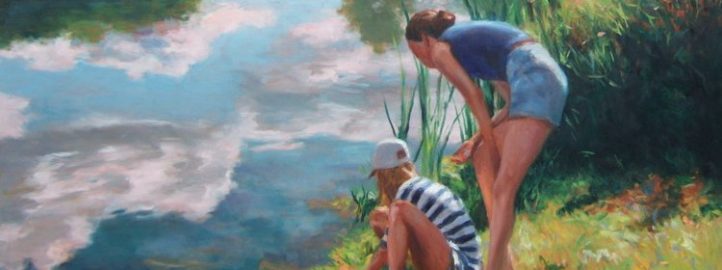
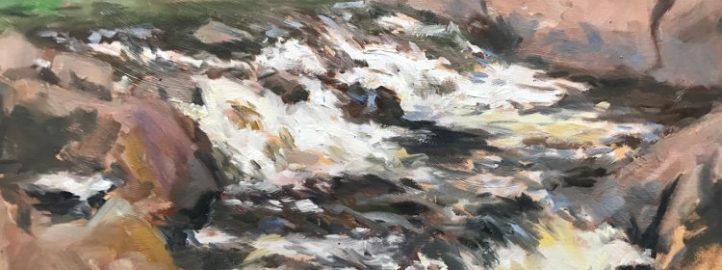
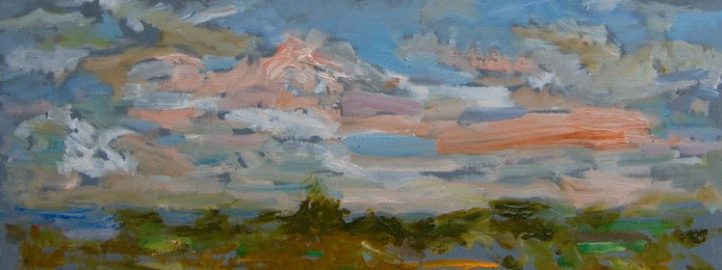
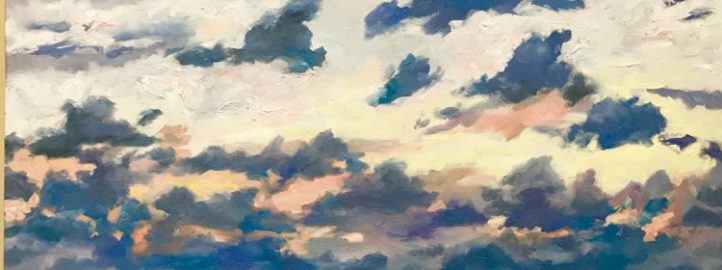
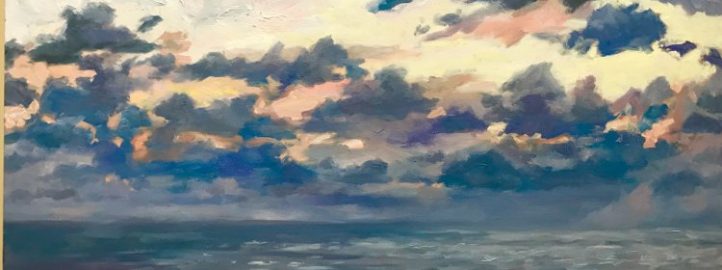
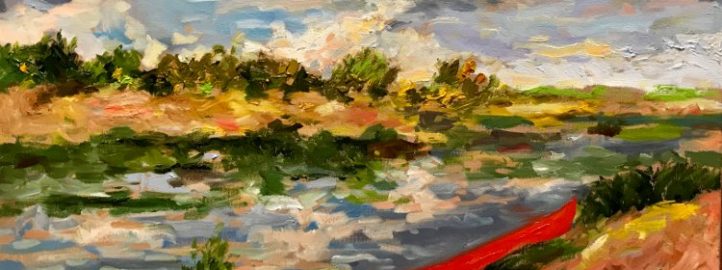
of this unique artist. After being immersed in his large oil landscapes,
one cannot deny the authentic artistic expression of someone who
has been surrounded by nature since his early youth; the images are
filled with trees, birds, streams and animals. Every brush stroke on the
canvas is a testament to his deep connection with nature, like visions
that are engrained in his subconscious that continue to inspire his
creative process. His paintings are easily distinguished by his unique
perception of the sky, at times leaving some raw edges, drawing the
observer into the landscape. The abundance of endless inspiration is
enough for two lifetimes. This is perhaps the reason Douglas reluctant-
ly steps away from the easel, hoping that all his ideas will eventually
materialize.
It can be said with certainty that Douglas’ mother Jean Edwards,
an opera singer, and his father, Stanley E. Edwards, a respected attor-
ney and passionate skier, are responsible for having provided a won-
derful, carefree childhood and solid foundation for their five boys. In
Douglas’ youth, his parents were looking for a suitable place close to
a ski resort for the family to spend weekends and vacations togeth-
er. They purchased a farm near Creemore, not far from Collingwood
and Blue Mountain, a true ski paradise. It turned out that this decision
had a lasting and meaningful significance for their five children, and
later their grandchildren, creating a lifetime of fond memories. These
memories are compiled in Stanley’s autobiography, “My Story”, which
Douglas unselfishly shares with me. He then enthusiastically pulls
out his mobile phone, sharing a video of his mother performing at a
charity event that was founded by Douglas’ late father. It is hard to say
whether he is prouder of his mother or father, both of whom have done
so much to enrich his life.
Douglas chose to study figurative art at the prestigious OCAD Uni-
versity, formerly titled the Ontario College of Art. In his fourth year, he
studied abroad in Florence, Italy. The journey to this world-renowned
artistic oasis can most-definitely inspire young artists, but at the same
time can be discouraging after seeing unimaginable treasures that one
feels they can never emulate. This juncture was particularly difficult
for Douglas who was questioning how to forge his own artistic path,
struggling between choosing his formal study, figurative art, or his
true passion, landscape art. Ultimately, Douglas chose to focus pri-
marily on landscape art despite creating an impressive collection of
figurative art.
Douglas’ life takes on an upward trajectory when he receives an
unexpected invitation; he is asked by a respected Serbian-Canadian
artist, Djuro Lubarda, to join artists’ colonies in Serbia, Republika
Srpska and Montenegro. This opportunity that Douglas accepts is a
life-altering experience in many ways. He primarily acknowledges the
generosity and openness of the Serbian people, which begins with the
obligatory shot of plum brandy; language barriers easily vanish in this
setting. Moreover, the artists’ simplicity of life, colonies’ tranquility
and their connection to nature is embellished with the backdrop of
breathtaking costal sunsets. Different priorities prevail in these new
surroundings where materialism takes a back seat to nurturing life-
long friendships and savouring the relevance of this unified connec-
tion. Zograf, Peko, Panto, Snezana, Milan, Pedja, Visegrad, Prilipac,
Susanj, Bokokotorski zaliv: names and places rhymed off by Douglas
in one breath as if these are places and people that he grew up with.
Douglas recounts his experiences below:
I met Zograf four years ago at my very first art colony in Visegrad,
Republic of Serbska. He doesn’t speak English and I don’t speak
Serbian, yet from the very first meeting I think we understood each
other and have grown to respect each other both as artists and as
people. Telling stories of the war, I could not imagine what horror
he went through along with most people there at that time. But
through that bad experience he has remained a kind, giving and
loving individual. He helped me enormously at the colonies, lend-
ing paint, materials and always sharing his ideas of how to improve
my art in a positive way. I watched him paint his unique techniques
in watercolor and oil over and over again with immense skill and
originality. “I studied at Smegotenska (a small village where he grew
up) Academia” he joked, and said he learned everything about art
from his professor, the local rooster. The rooster taught him free
and unique art. Expressing his experiences from the war gives his
work depth and value. In some abstract way you can see the bombs
going off, the people suffering, the pain in many of his paintings.
But there is also a beauty and harmony. I think it’s his way of deal-
ing with his experience in a healthy positive way.
We remained in contact and this year I met him for three art
colonies. “The rakija is 20 years old” he said on our first meeting
in four years as we cheered and drank the bottle. He always looked
out for me every step of the way with generosity as we again had the
pleasure of working and painting together. He has truly enhanced
my experience, respect and appreciation and love I have for of that
part of the world and the people there. 1)
Little did Douglas know when he was attending school in Florence,
the impact the other side of the Adriatic Sea would have on in his
life. Overall, Douglas feels embraced not as a foreigner, but as “one of
them”, now old friends as he intends to spend more time in that part of
the world. After these Serbian connections were established, Douglas
recently participated in a memorable show in Toronto at the Serbian
Heritage Academy gallery.
After conversations and meetings with Douglas, I felt privileged
getting to know a man and fellow artist of such high calibre. I am per-
sonally more interested in an artist’s life story as it relates to their work
and development rather than simply dissecting their artistic creations.
There is no doubt that this article, which is one of many devoted to
Douglas, would not inspire an individual to research his life’s work in
more depth. His work has been chronicled in such magazines as Art
Impressions, Art Trends, Arabella, Magazin Art, et. al.
I hope that one day art will have the ability to unify all people,
regardless of their differences. Douglas’ experience should encourage
others to cultivate tolerance, leave preconceived notions behind, and
embrace friendship and cooperation through the love of art.
_________________________
1) Edwards, Douglas. “Zograf.” E-mail to the author. 16 Nov. 2017.

Michael Galovic
Curriculum vitae
Born in Belgrade, Yugoslavia, into an artistic family, Michael began
absorbing the ancient tradition of iconography in early childhood. He
is a graduate from the Belgrade Academy of Applied Arts in 1974, de-
partment of graphic art and printmaking.
Following a personal quest, Michael travelled widely and lived and
worked in Spain, Middle East and Africa, absorbing the contrasting
beauty of each new culture. Australia became his new home in early 1990.
He had many shows all over Australia, Sydney and Melbourne in
particular.
Overseas one man shows up to date: Peru, USA, United Kingdom,
New Zealand, Serbia, South Korea, New Caledonia, France, Ecuador,
Ethiopia, Marquesan Islands, Slovenia.
Michael Galovic engages himself in a few parallel directions: trad-
itional icons, contemporary religious and contemporary non religious art.
Apart from numerous private art collections, Michael’s works can
be seen in over one hundred churches and institutions throughout
mainly Australia and in other countries, especially New Zealand.
Four times finalist in the Blake Prize and twice in Mandorla exhib-
itions of contemporary religious art, Crucifixion, Stabat Mater, Trans-
figuration and Resurrection are themes he is particularly focused to,
but he has also been building a body of work on Uluru, the sacred Rock
in the Northern Territory of Australia for some 20 years now.
His favourite medium is egg tempera, but he is ever interested in
gilding and experimenting in general, constantly exploring and ex-
panding his own boundaries, always reinventing himself as an artist.
Michael Galovic’s work has been reproduced in books:
Basil of Cesarea. Questions of the Brothers, by Anna Silvas; Windows
to Orthodoxy, by Dr Guy Freeland; Beyond the Shattered Image, by
John Chryssavgis; Jesus Laughing and Loving, by Major Issues and
Theology Foundation LTD; The Many Faces of Christ, by Addwall Pty
Ltd, God Among Us, Australian Images of Jesus, by Marie T. Farrell;
Icons+Art: Michael Galovic, co-published by the Honeyset Press and
the artist; Sunce јužnog neba, Pogled na umetnost u Australiji danas,
by Zoja Bojic; Religious Education Text Books by the Catholic Educa-
tion Offices in Victoria and NSW, Australia.
Magazines and other publications:
Lavalla; Madonna; Australian Catholics; Melbourne Catholic; The
Catholic Weekly; Phronema; Vema; Australian Religious Diary; Mary
MacKillop: A Tribute; Christians in the Visual Arts, Directories (USA);
Divine Temple, Contemporary Christian Art (Russia); Various Angli-
can Magazines; Aurora ; Serbian Voice (Serbian in Australia); Vesti
(Serbian outside of Serbia); Novosti (Serbian in Australia); Calendar
Salt of the Earth, A Christian Seasons Calendar 2017/2018, by United
Church if Canada, Vancouver; Marist Brothers Brasil; Central Coast
NSW Advocate; Politika (Serbian daily in Serbia); Kultura (Serbian in
Australia); Touching Hearts; The Paraclete, Eremos, Craft Arts Inter-
national; GALOVIC and the Marists, by Marist Brothers, Australia…
Appeared on ABC TV(Compass, Sunday Arts); ABC radio Religious
Program; SBS, both TV and radio programs (interviews by the Serbian
and Spanish stations) in Australia.
Self-published booklets: The Son of Man, Uluru. To be published:
Jesus the Christ: Life, Crucifixion and the Resurrection through trad-
itional icons and contemporary art by Michael Galovic.
Michael Galovic
Let me tell you three stories
In my eye nests your beauty
Some 60 years ago, in the country called Yugoslavia, a little boy was
holding his mother’s hand as they were standing in an Orthodox
church, watching the re-appearance of old frescoes. All around them
were those austere Byzantine saints who fill little viewer with fear and
guild, however misplaced!
The step-father, Rufim, and his team of conservators and restorers
have just detached a mortar layer that had covered frescoes from 13th
and 14th centuries. These now emerged into the light of the day for
the first time in over 500 years. There is an excitement in the air, also
commotion as something has been discovered in the outer vestibule.
On the north part of the west wall, they have found an inscription,
totally unexpected and out of place. It was thought to have been writ-
ten in Arabic script people said, but the fullness of the mystery was to
be revealed later.
The inscription represented a verse composed by the great Persian
poet Hafiz (1320?-1389), written in the Persian language and yet, it was
incised in Arabic script over the fresco. One of the possible translations
is: “The pupil of my eye is the nest to your beauty”.
We shall never know who the erudite traveller was; he, who pro-
foundly affected by this beauty of another kind, gave orders to the cal-
ligrapher to engrave the inscription. Never mind that infidels created
such a beauty, its presence made him bow to it, pay respects and let
his heart declare it to posterity, as shortly afterwards, the church walls
would be rendered, to be made visible again only 500 years later.
The noble traveller, possibly a chronicler of events for the con-
quering Turkish army, rose above his own religious background to
recognise and acknowledge the transcendent Beauty which shines for-
ever undisturbed in the beyondness. It was a salutation to the eternal
celebration of man’s closeness to the Divine.
This hugely important event is, lamentably, almost completely un-
known, both internationally and even locally. You would be guessing
correctly if you said that the medieval town was Prizren, one of the
centres of Serbia in 14th century, and the little boy was me. It is not
improbable that this wonderful event planted a decisive seed in me,
to become an iconographer myself. After I first tried myself in what
I thought was icon painting, here I am, almost 50 years later, still at-
tempting to produce this “perfect” icon.
Sailing back to Byzantium
After many moons and almost full of days, I might decide to sail BACK
to Byzantium, using the gentle force of Grace to fill my sails. On arrival
in the golden city, I will see a banner reading: “This no country for
old men”, to which I will whisper: “I have never been old in my life!”.
Then, with the audacity of an old man with nothing to lose, I shall go
to the Royal Palace and ask for an audience to present my icon to the
Emperor.
Grey of hair, eyes wide open, heart singing, absorbing the golden
splendour of the Palace, I would be finally brought before the Emperor.
The icon I have been making all my life shall be presented with my
hands duly covered as is customary at Byzantine Court.
With an air of solemnity and otherness, the unibrow Porphyro-
genitus inspects the icon closely for an unbearable long moment…
“She is perfect”, he finally declares, with his face betraying a pass-
ing disbelief.
“The apple of my eye is the nest to your beauty”, he concludes,
mostly to himself. He leaves, not even glancing at me. After all, I am
but an instrument, a vessel, not a Creator. At best, I am the extended
hand of the Creator.
My eyes are now closed, tears rolling down my cheeks, I am finally
at home.
Saint Luke Painting the Crucifixion
There are a number of icons with Saint Luke painting the Mother of
God with Child, thus making him the first iconographer; some of them
are attributed to Domenicos Theotokopulos before he went to the West
and became famous as El Greco (The Greek).
One of them, though, stands out for me. That icon, in the Moraca
monastery, Montenegro, was painted between 1672 and 1673 by an un-
known master although some attribute the work to Avesalom Vujicic.
It is the most splendid piece: with an impeccable composition,
pleasing chromatic balance and overall, masterly execution. On his
artist’s easel, Saint Luke is painting the Hodegitria (She Who Points
the Way) type icon, believed to be the prototype for the many to follow.
Throughout the years of my iconographic practice I have made sev-
eral replicas of this masterpiece.
In 2010, I decided to incorporate it in a contemporary religious art-
work. For a while and still, I have been exploring the phenomenon of
ambiguity and ambivalence in contemporary religious art through a
fusion of old and new, with a juxtapositioning of seemingly different
and irreconcilable worlds, very often using the old icons in a new set-
ting where they assume a different meaning and impact.
On a 120 x 90cm panel, I replicated St Luke from the Moraca mon-
astery icon in the action of painting. That was done as per the original,
using traditional techniques, tempera and gold leaf. However, the icon
on his easel was not Hodegitria but the Crucifixion itself; the saint was
sitting and painting in front of the crucified Christ, the ultimate drama
of mankind.
The background and the figure on the cross were delivered in a
contemporary, “abstract” way, using Dutch gold, acrylic and Black
Japan. The juxtaposition of those two realms tells us about the stable,
conservative, reliable and anchoring realm (St Luke) while the ab-
stract realm of the Crucifix and the background stands for the ever
changing and evolving, dynamic, vibrant, chaotic and volatile world. It
is in the precarious balance between those two polarities that life itself
keeps unfolding.
There is a further dimension: The Crucifix that St Luke is painting,
and the way in which we see it on his easel, is entirely unlike what he
sees in front of him. This is an allusion to the perception game, known
from ancient time-sand even present in the Gospels which differ in
recording the same events. Akira Kurosawa’s film, ‘Rashomon’, which
is about four different witnesses who give very different accounts of
the event they witnessed, establishes an excellent paradigm of the per-
ception issue.
The work is completed by the use of the fractured frame which is to
remind us of the fragmentary nature of all life, as nothing really lasts
in a long and uninterrupted line but in a series of segments and frag-
ments. This fractured frame is also an allusion to broken humanity
and the imperfection of man’s nature.
The colours used for the frame are borrowed from the chromatic
symbolism of icons: red for the Divine and blue/green for the Human
nature of Christ.
Saint Luke Painting the Crucifixion was selected and displayed as
a finalist in the Blake Prize for Religious Art in Sydney in 2010 and is
now part of the permanent art collection of Sydney Riverview College.
Mervyn Duffy
The Otherness of Christ
A theological reaction to a series of icons of the Transfiguration.
Michael Galovic is an artist and icon writer of considerable repute in
Australia and New Zealand. A Yugoslav by birth, he is a graduate from
the Belgrade Academy of Arts. Since 1990 he has made his home in
Australia and his work can now be seen in over one hundred church-
es and institutions throughout Australasia. The Crucifixion and the
Stabat Mater are subjects he has often addressed, but he declares that
he wants to move on and bring the Resurrection into focus in his art
and, as a step on that journey, in 2016 and 2017 he produced the Trans-
figuration icons that sparked this reflection.
There is a strong thread of iconoclasm running through Chris-
tianity. Iconoclasm involves a distrust (and destruction) of religious
imagery because of a recognition of the utter transcendence of God.
God is completely Other from everything in Creation and any creat-
ed artwork representing God is in danger of being treated as an idol.
When an image receives the worship that is due to God alone then the
commandment is broken – “You shall have no other gods before me.
You shall not make for yourself an idol, whether in the form of any-
thing that is heaven above, or that is on the earth beneath, or that is in
the water under the earth. You shall not bow down to them or worship
them.” (Exodus 20:3-5a)
The religion of Judaism, which shares with Christianity the Ten
Commandments (and most of what we call the Old Testament), inter-
prets that Exodus passage as forbidding the religious representation
of humans and animals. Islam is similarly aniconic – forbidding the
representation of sentient beings.
What distinguishes Christianity from Judaism and Islam is what
we claim about the person and dual nature of Jesus Christ. We hold
Jesus to be both human and divine. This has a huge number of impli-
cations, one of which was spelled out by St John of Damascus in the
heated debate on sacred images in the early 700s:
Therefore I venture to draw an image of the invisible God, not as
invisible, but as having become visible for our sakes through flesh
and blood. I do not draw an image of the immortal Godhead. I
paint the visible flesh of God. Against Those Who Decry Holy
Images, 6.
The Damascene goes on to cite the passage of John’s Gospel where
Jesus says “Whoever has seen me has seen the Father.” (John 14:9) and
the passage from St Paul where he declares that Jesus “is the image of
the unseen God” (Colossians 1:15). He argues that we cannot depict a
spirit, and God is spirit, but we can depict Jesus because he became
flesh. Jesus is the true icon of God the Father and therefore we may
make holy images of Jesus and the saints. The incarnation is the justi-
fication for icons. When God became human, God became visible and
tangible. They dined with him, they walked and talked with him. Jesus
shows us the Father, Jesus shows us God. Because of the coming of
Jesus Christ as an historical person, in one place and one time, Christi-
anity permits images of him to be made and to be venerated.
This was expressed by the bishops gathered at the Second Council
of Nicaea in 787 AD when they solemnly taught:
We decree with full precision and care that, like the figure of
the honoured and life-giving cross, the revered and holy images
(εικóνας), whether painted or made of mosaic or of other suitable
material, are to be exposed in the holy churches of God, on sacred
instruments and vestments, on walls and panels, in houses and by
public ways; these are the images of our Lord, God and savior, Jesus
Christ, and of our Lady without blemish, the holy God-bearer, and
of the revered and angels and of any of the saintly holy men. The
more frequently they are seen in representational art, the more are
those who see them drawn to remember and long for those who
serve as models, and to pay these images the tribute of salutation
and respectful veneration. Certainly this is not the full adoration
in accordance with our faith, which is properly paid only to the
divine nature, but it resembles that given to the figure of the hon-
oured and life-giving cross, and also to the holy books of the gos-
pels and to other sacred cult objects. Further, people are drawn to
honour these images with the offering of incense and lights, as was
piously established by ancient custom. Indeed, the honour paid to
an image traverses it, reaching the model; and he who venerates
the image, venerates the person represented in that image. (Tanner,
Decrees of the Ecumenical Councils. Vol 1, 135-6)
Ever since this Ecumenical Council, the Catholic Church has dis-
played holy images in worship and in catechesis, in cathedrals, parish
churches, roadside shrines, and family homes. These images are meant
to attract us, to serve as models, to remind us of great deeds of God and
for God. When we see Christ in an icon we are encouraged to relate to
him, to greet him, to pray to him, to honour him, to worship him. The
icon is quasi-sacramental, a channel of grace and a path of communi-
cation with the divine. Icons are kissed, candles are lit before them,
flowers put beside them.
The humanity of Christ is easily able to be depicted, the perennial
challenge for sacred artists is how to hint at his divinity. Various artistic
conventions have been used – the gold background, a red background,
imperial garments, the halo, the mandorla (the almond-shaped slice of
heaven surrounding the Christ). We are so used to these conventions
that we take them for an ordinary part of the painting, but it is import-
ant to recognise them for what they are – unusual features that have
Jina Mulligan
A sacred work of art
Michael Galovic is a Serbian artist who has made his home in Aus-
tralia for the past 27 years. He is renowned for creating works of sacred
art that are artistically and spiritually challenging. He was recently
commissioned by St Columba’s Girls College in Essendon to create The
timeless dance, a work that celebrates women and invites us to en-
counter the divine.
It is interesting to consider what motivates Michael Galovic to con-
tinue to create his special works of art, and how it is that, time and
again, his sacred art carries the ability to awaken and delight our sens-
ibilities and lead us to a better understanding of spirit.
A visit to Galovic’s studio on the Central Coast of New South Wales
may shed some light. When I made the journey some years ago, I found
a number of works in progress and a creative space that reflected Galo-
vic’s aura of gentleness and serenity. What became evident was a ‘buzz’
that lingers in the viewing of his work—a positive vibe that speaks of
absolute dedication; a layer of energy he has perfected in the pursuit of
a true, grounded passion for his work.
Galovic’s traditional icons and contemporary sacred works em-
bellish churches, schools, provincial houses and private dwellings
throughout Australia and the world. Commissions too numerous to
mention have been accepted and tackled with zeal. In viewing the
work in Galovic’s studio, I wondered what it was that inspires him to
keep coming up with these interesting and thought-provoking works
of art. His recent work, The timeless dance, gives significant insight
into his ongoing passion.
The timeless dance was commissioned by St Columba’s College
in Essendon. The prospectus for the girls’ college is titled ‘Uncom-
mon women’. Galovic explains that he wanted this work to celebrate
women, sung and unsung. His idea was to honour women in gener-
al—those who enable others and those who take responsibility with-
out desiring personal acclaim. He selected Miriam, the courageous
sister of Moses, for his central motif: a figure mirrored in the dancing
women arranged shoulder to shoulder around the circumference of a
circle. Who better than the iconic figure of Miriam to awaken a sense
of leadership and vitality in a school community? Miriam knew what it
was to experience both despair and hope, terror and deliverance, slav-
ery and freedom; to experience being disregarded and being valued.
She seems in many ways to be just like us. It is helpful to be mindful of
her experiences when we ask ourselves whom we should listen to and
allow to influence us.
The revolving figures in the painting are solidly connected, enhanced
by their aristocratic dress and trailing sashes, suggestive of an endur-
ing commitment. In typical Galovic style, he has carefully chosen the
perfect iconic device to press home his aim to celebrate remarkable
women and, at the same time, inspire young women to become re-
markable. Little wonder the women in the central panel dominate the
triptych. It is this panel we are drawn to, first and last. We look direct-
ly at the figures—each one connected and yet displaying a satisfying
uniqueness; each one joyful in the execution of the celebratory dance.
On each side of the central panel is a vibrant, colour-filled panel
supporting the mesmerising centre. The powerful effect of the triptych
is a sense of harmony that flows through the three panels. In view-
ing The timeless dance, we become aware of the vital interconnected-
ness of the three panels. Galovic tells us that the panels represent past,
present and future. He is keen to represent energy as ever fluid and
moving in vibrant, circular motion with no beginning and no end. We
become very much aware of the past and the future echoed in the cen-
tral panel of the present — the Christian idea of the incomplete leading
contemplatively to the fulfilled.
A red thread moves through the three panels. As the Chinese prov-
erb tells us, ‘an invisible red thread connects those who are destined
to meet, regardless of time, place or circumstance. The thread may
stretch or tangle but will never break.’
Galovic involves his audience in his personal history, drawing
them into his early experience in Yugoslavia—as a small boy holding
his mother’s hand, standing in the Orthodox church and watching as
his stepfather and a team of conservators detach layers of mortar to
reveal frescoes from the thirteenth and fourteenth centuries. Galovic
carries the excitement from that room of his boyhood experience into
the workshop space and his works of art.
Each of the many specially commissioned works Galovic has com-
pleted over the years carries its own unique significance. He dedi-
cates himself to each task in order to create something beautiful and
thought-provoking. The engaging experience of Galovic’s art work is
deeply grounded in a mindfulness of the creator. Each work carries
a hint of transcendent beauty and disappears momentarily into the
divine. The process acts as an enabler to transcendence. We experience
the flow of divine energy in the act of participation with his creation.
Galovic promotes a powerful sense of connection through his
work—a hint of beauty inscribed in the sacred. The invisible thread is
made visible. It endures and connects us with the gift of vital energy
as it streams from the divine, expanding our hearts and enabling our
moments of difficulty to be made easier.
Galovic’s art throws up ever changing images. He works tirelessly
to arrive at suitable images that will suggest what is so difficult to ex-
press. The images grab hold of us and drag us into the present moment.
And isn’t this the marvel of the creative process? To allow us to face up
to the connection between past and future … and to recognise it when
it is represented so positively in our glorious present?
However we interpret Galovic’s work, we can appreciate the process
of creativity that is enduring. We are grateful for the images that allow
us to open ourselves to a better understanding of creation. Images that
allow us to connect to our essential selves in a moment of wonder. A
moment in our timeless dance.
Robert Hiini
Michael Galovic and the Marists
Michael Galovic isn’t interested in playing it safe and neither, evident-
ly, are the Marists who have commissioned the Central Coast icon-
ographer and painter again and again over the past twenty-one years,
resulting in works at once reverent and penetrating.
It’s the way art is meant to be, Mr Galovic told Marist brothers and
principals at the 16 March launch of Galovic and the Marists, an illus-
trated book commemorating the relationship, with commentary by Br
Michael Green FMS.
“(As an artist) you must try to dig out things from yourself, things
you never knew existed – that you are incapable of,” Mr Galovic told
the gathering.
“It can be so powerful – aesthetically, artistically, spiritually – that
it engages the viewer, that it starts the dialogue.
“The questions (then) come: why is it like this and why not like
that? Anything, brothers, anything but indifference is good.”
The Yugoslavia-born Galovic has been constantly re-creating and
re-imagining his craft for the past 47 years, the last 27 spent in Aus-
tralia.
His work now adorns Catholic, Orthodox and Anglican churches
and colleges throughout Australia, and further afield.
As a corpus, it is an amalgam of, on the one hand, traditional icon
painting – sometimes called writing – in which 90 per cent of a work
might be copied from earlier antecedents – and on the other, more
conceptual works that pursue abstract depiction where purely illustra-
tive modes might prove insufficient.
Marist provincial Br Peter Carroll spoke of the book, and of Mi-
chael Galovic’s work more generally, as a confluence of “Athens and
Jerusalem” – of the cerebral and the visceral.
“Beauty is something that we all aspire to, particularly these days
when the situation in our world is so difficult and so fraught,” Br Car-
roll said.
“Most of all … it’s in the goodness of God. There (in Michael Galo-
vic’s art) is an invitation to meet the God that we all aspire to.”
Speaking at Marist Brothers HQ in Mascot to a gathering that
largely consisted of Marist Principals from throughout Australia, Br
Carroll recounted the prescriptive longing of the Russian novelist and
journalist, Fyodor Dostoyevsky, that “beauty will save the world.”
“That beauty is captured here: it’s captured in the lives of Marists;
it’s captured in our founders; and it’s captured in the people.”